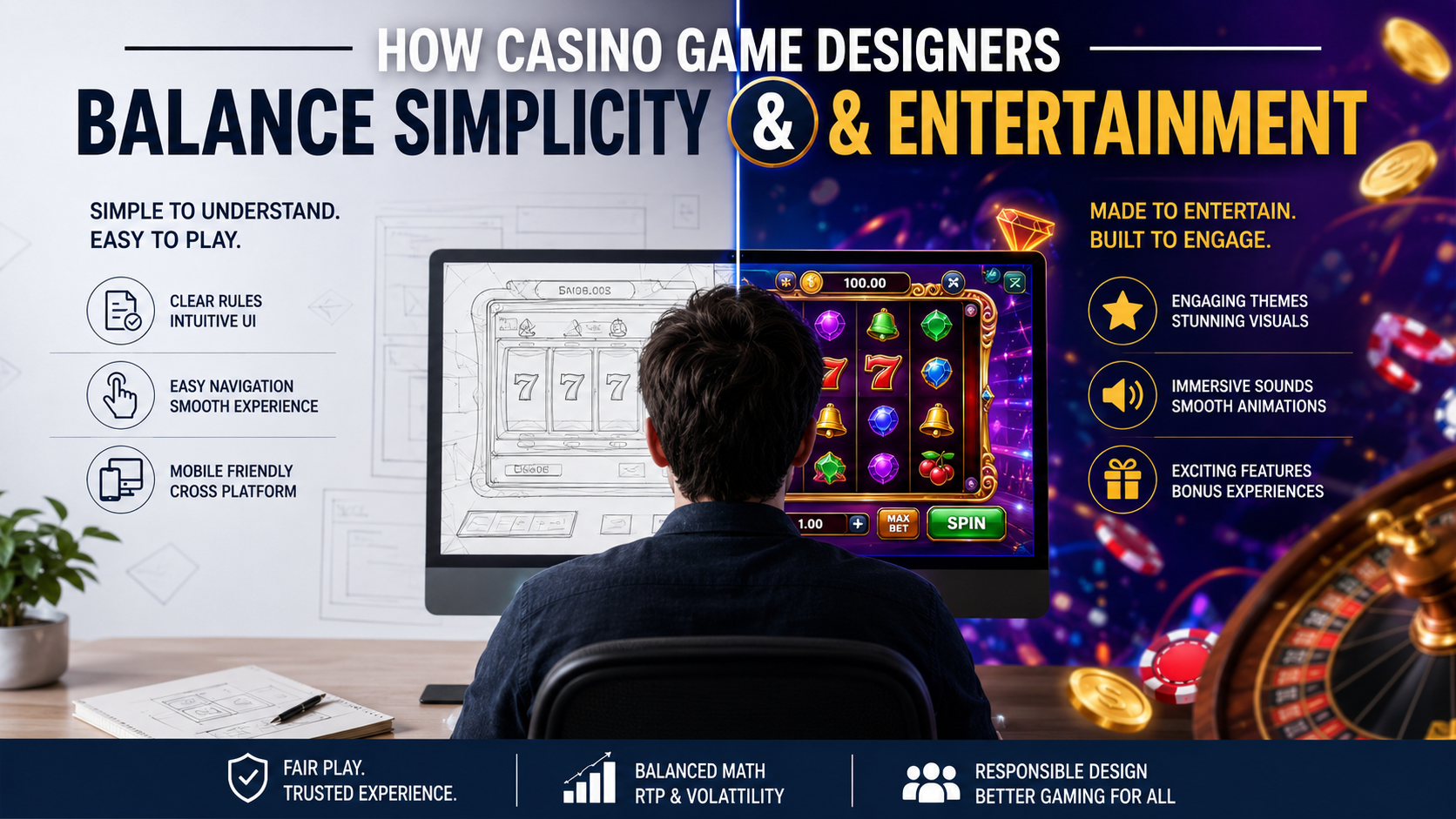
Casino games may look simple on the surface, but creating one that keeps players interested without making the experience confusing is a surprisingly complex process. From the rules and interface to sound effects, animations, bonus features, and game speed, every element has a purpose.
For casino game designers, the challenge is finding the right balance between simplicity and entertainment. A game needs to be easy enough for a new player to understand while still offering enough visual appeal and variety to remain interesting.
This balance has become even more important as casino games are increasingly played on smartphones and other smaller screens.
Why Simplicity Matters in Casino Game Design
The first few seconds of a game can determine whether a player understands what to do or simply moves on to another title.
Simple design does not mean a game has to be boring. Instead, it means the core mechanics should be easy to recognise.
For example, a basic slot game may require only a few actions: choose a stake, start the game, and understand the winning combinations. If the interface is overloaded with unnecessary buttons and complicated instructions, the basic experience can quickly become frustrating.
Good designers therefore focus on:
- Clear menus and buttons
- Easy-to-understand game rules
- Readable information
- Simple navigation
- Consistent visual elements
- Fast access to important features
The objective is to remove unnecessary friction while keeping the game visually appealing.
Entertainment Goes Beyond Graphics
Modern casino games often use impressive graphics, but entertainment is not simply about making a game look attractive.
Designers consider the entire player experience. This can include animation, sound, themes, pacing, bonus rounds, interactive elements, and the way information is presented.
A well-designed game might use a strong theme to create an atmosphere. A fantasy game could feature mythical characters and colourful environments, while a traditional table game might use a more sophisticated visual style.
However, every feature needs a reason to exist. Adding animations simply because they look impressive can make a game feel cluttered or slow.
The best designs use visual and audio elements to support the game’s main idea rather than distract from it.
Creating a Learning Curve Without Overcomplicating the Game
Another important consideration is the learning curve.
Casino games can attract players with very different levels of experience. Someone familiar with blackjack may immediately understand the rules, while a beginner may need additional guidance.
Designers can solve this problem by introducing information gradually.
Instead of presenting every rule and feature at once, the interface can highlight the most important information first. Additional details can remain available through help menus or information sections.
This approach creates a smoother experience because players can understand the basics before exploring more advanced features.
Clear explanations are also important for transparency. For regulated markets, game information and outcomes must meet specific standards. For example, the UK Gambling Commission explains that online gambling games using random number generators must undergo appropriate testing before being offered to players.
The Role of RTP and Game Mathematics
Behind the visual experience is another important part of casino game design: mathematics.
Designers need to establish probabilities, payouts, volatility, and other mathematical characteristics before a game can be properly implemented.
One commonly discussed measurement is Return to Player (RTP). It represents the theoretical percentage of stakes that a game is designed to return over a large number of plays. It does not mean that an individual player will receive that percentage during a particular session.
The UK Gambling Commission notes that RTP is an average measured over a significant number of game plays rather than a guarantee for an individual session.
Volatility is another consideration. A high-volatility game may have larger but less frequent wins, while a lower-volatility design can involve smaller and more frequent outcomes.
These mathematical foundations have to work alongside the entertainment layer. A game can look fantastic, but if its mechanics are difficult to understand or poorly communicated, the overall experience can suffer.
Mobile Design Has Changed the Approach
Smartphones have changed how casino games are designed.
A desktop screen gives designers more space for menus, animations, statistics, and additional features. A mobile screen does not have the same luxury.
As a result, mobile-first design usually prioritises essential information.
Buttons need to be large enough to use comfortably. Important information should remain visible without making the screen feel crowded. Animations also need to run smoothly without creating unnecessary delays.
This is where simplicity becomes a competitive advantage. A clean interface can make a complicated mathematical system feel much easier to interact with.
Why Sound and Animation Need Restraint
Sound effects and animations can make a casino game feel more immersive, but too much stimulation can have the opposite effect.
Imagine a game where every small action triggers a long animation, multiple sounds, and several pop-ups. Even if the individual elements are attractive, the overall experience can become tiring.
Designers therefore pay attention to timing.
Short animations can provide feedback without interrupting the flow. Sounds can reinforce important events without becoming repetitive. Visual effects can highlight significant moments rather than appearing constantly.
This creates entertainment while maintaining usability.
Responsible Design Is Part of the Balance
Entertainment should not come at the expense of responsible design.
Modern game development increasingly considers how features influence player behaviour. Regulators have also introduced requirements around responsible product design.
For example, UK Gambling Commission guidance states that gambling products should not actively encourage players to chase losses, increase their stakes, or continue gambling after indicating that they want to stop.
Research into online game design changes has also examined factors such as play intensity and enjoyment, showing why game mechanics and player experience need to be considered together.
This means successful game design is not simply about maximising attention. It is about creating an experience that is understandable, transparent, engaging, and appropriately designed for its intended audience.
Testing Helps Designers Find the Right Balance
Before a casino game reaches players, designers can test different versions of its interface, features, pacing, and presentation.
Testing can reveal problems that may not be obvious during development. A button might be difficult to find, instructions might be unclear, or an animation might take too long.
Mathematical testing is equally important. Game outcomes need to perform according to their intended probabilities and specifications. Regulatory frameworks such as those maintained by the UK Gambling Commission place significant emphasis on testing and monitoring game fairness.
The result is a development process where entertainment and functionality are evaluated together.
How Online Gaming Platforms Benefit From Better Game Design
Players today have countless options, so a platform needs more than a large game library to create a positive experience.
A well-organised online sports and casino gaming platform can make it easier for users to discover different categories, understand available games, and navigate between sections without unnecessary confusion.
For platforms such as CricBet99, the broader user experience can be strengthened when game information, navigation, and content are presented clearly and responsibly.
The important point is that good design should support the user rather than overwhelm them.
FAQs
What makes a casino game easy to understand?
A clear interface, simple rules, readable information, and intuitive controls make a casino game easier to understand. Players should be able to identify the main objective without studying a complicated interface.
Why do casino games use animations and sound effects?
Animations and sound effects can provide feedback, establish a theme, and make important moments more noticeable. Effective designers use them selectively so they enhance rather than distract from gameplay.
Does RTP guarantee how much a player will win?
No. RTP is a theoretical long-term average based on a large number of game plays. It does not guarantee a specific result for an individual player or session.
What is game volatility?
Volatility describes how a game’s outcomes are distributed. Higher-volatility games can have larger but less frequent wins, while lower-volatility games tend to have smaller and more frequent outcomes.
Why is mobile-friendly casino design important?
A large proportion of digital gaming takes place on mobile devices. Mobile-friendly design makes controls easier to use, information easier to read, and navigation more comfortable on smaller screens.
Final Thought
The strongest casino games are rarely the ones with the most features. They are the ones where every feature has a clear purpose.
Game designers have to make complex mathematics, visual presentation, sound, controls, and rules work together without overwhelming the player. Simplicity provides accessibility, while carefully planned entertainment gives the experience personality.
When these elements are balanced correctly, a casino game can feel straightforward at first glance while still offering a polished and engaging experience underneath. That combination is what makes thoughtful game design stand out in an increasingly competitive online gaming industry.