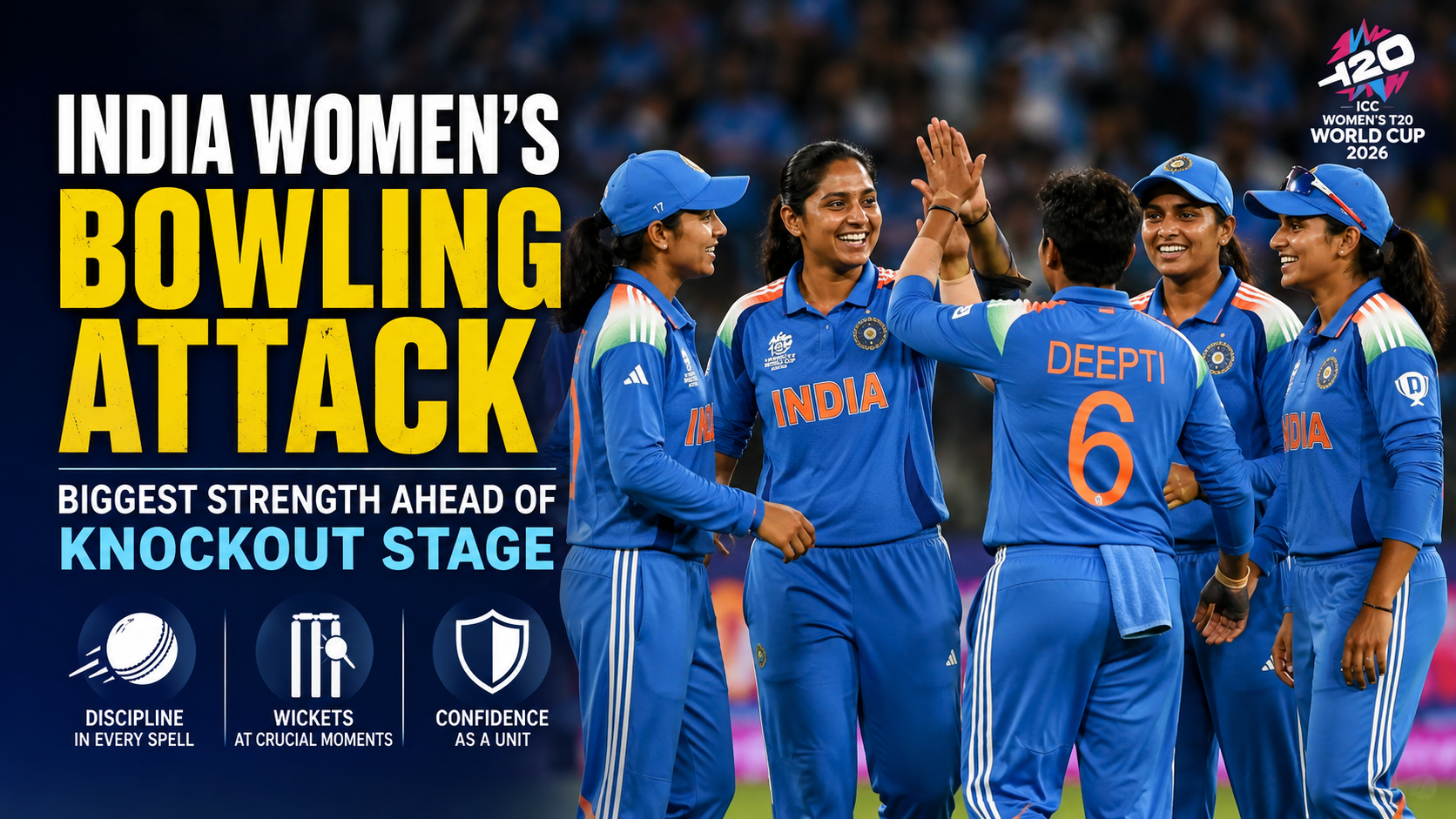
India Women’s Bowling Attack Emerging as the Team’s X-Factor before the Knockouts
India Women have built a reputation for producing world-class batters, but their journey in the Women’s T20 World Cup 2026 has highlighted a different story. While runs from the top order have certainly helped, it is the bowling unit that has quietly laid the foundation for many of the team’s victories. As the tournament enters its most important phase, India’s bowlers are becoming one of the biggest reasons why fans believe the team can challenge for the title.
Every successful T20 side needs a bowling attack capable of handling pressure, controlling scoring rates, and taking wickets at key moments. India have shown all three qualities throughout the competition. Even when opposition teams appeared to be building momentum, Indian bowlers found ways to regain control and shift the match back in their favour.
A Bowling Unit Built for Modern T20 Cricket
The biggest advantage India possess is variety. Modern T20 cricket is no longer about relying on one superstar bowler. Teams need multiple options capable of adapting to different situations, pitch conditions, and opposition strategies.
India’s bowling group offers exactly that balance. The attack includes experienced campaigners who understand pressure situations and younger players eager to make an impact on the international stage. This combination allows the team to remain flexible regardless of the match scenario.
Whether India need wickets during the powerplay, control through the middle overs, or disciplined execution at the death, there is usually a bowler capable of fulfilling that role.
That flexibility becomes especially valuable during knockout matches, where a single over can decide the outcome of an entire tournament.
Deepti Sharma Continues to Deliver When It Matters
One of the major reasons behind India’s bowling success has been the consistency of Deepti Sharma. Over the years, she has developed into one of the most dependable all-rounders in women’s cricket.
What makes Deepti particularly dangerous is her ability to contribute in different ways. She does not rely solely on taking wickets. Her economical spells often force batters into mistakes, creating opportunities for other bowlers at the opposite end.
Throughout the tournament, Deepti has repeatedly broken important partnerships and slowed scoring rates during crucial phases. Her calm approach under pressure makes her a natural leader within the bowling group.
For younger bowlers entering high-pressure knockout matches, having an experienced performer like Deepti provides stability and confidence.
Young Talent Adding a New Dimension
A major positive for India has been the emergence of young bowling talent. Several newer faces have shown they are capable of performing on the biggest stage.
Among them, Shree Charani has attracted significant attention. Her ability to generate breakthroughs has added an extra dimension to India’s attack. Rather than simply containing runs, she has consistently looked for wickets, a quality that often separates good bowlers from match winners.
The rise of younger bowlers also means opposition teams have less data and experience against them. Unfamiliarity can create uncertainty among batters, which often works in the bowler’s favour.
For India, this blend of youth and experience could become a major advantage as the competition intensifies.
Why Middle-Overs Control Is So Important
Many T20 matches are decided during the middle overs. Teams often focus heavily on power play scoring and death-over finishing, but the period between those phases can determine who gains control of the game.
India’s bowlers have performed particularly well during this stage of innings.
By restricting boundaries and forcing batters to take risks, they have created pressure that frequently results in wickets. This approach not only limits scoring opportunities but also disrupts the opposition’s plans for acceleration later in the innings.
In knockout cricket, where pressure naturally increases, the ability to dominate the middle overs becomes even more valuable.
Responding Well to Challenges
No tournament campaign is completely smooth, and India have faced their share of obstacles.
Injuries and squad adjustments have forced the team management to rethink combinations and assign additional responsibilities to certain players. Despite these setbacks, the bowling group has responded impressively.
Rather than depending on one individual, different bowlers have stepped up at different moments. This collective contribution is often a sign of a strong championship contender.
Teams that rely on a single star performer can struggle when that player has an off day. India’s bowlers have shown they possess enough depth to avoid that problem.
The Knockout Challenge Ahead
The knockout stage presents a completely different challenge compared to the group phase.
Opposition teams become stronger, pressure increases, and mistakes become more costly. Every over is scrutinized, and momentum can shift rapidly.
Against elite batting line-ups, India’s bowlers will need to maintain the discipline they have shown throughout the tournament. Dot balls, smart field placements, and well-executed plans will be just as important as wickets.
The encouraging sign for India is that their bowling attack appears prepared for those demands. The group has already demonstrated the ability to perform under pressure and adapt to changing situations.
If that trend continues, India will enter the knockout rounds with genuine confidence.
Bowling Could Be the Difference Between Success and Disappointment
T20 tournaments are often remembered for spectacular batting performances, but championship-winning campaigns are usually built on strong bowling.
The ability to defend modest totals, stop momentum, and take wickets in crucial moments often separates champions from the rest of the field.
India’s bowlers have shown they possess those qualities. Their performances throughout the tournament suggest they are capable of competing against any batting unit in world cricket.
While the spotlight may remain on the batters, the bowling attack could ultimately become the deciding factor in India’s pursuit of a Women’s T20 World Cup title.
Final Thoughts
As India prepare for the knockout stage, their bowling attack is emerging as one of the team’s greatest strengths. The combination of experience, youthful energy, tactical variety, and composure under pressure gives the side a solid platform to challenge the tournament’s best teams.
The batters may grab the headlines, but the bowlers have quietly built India’s campaign. If they continue producing disciplined and impactful performances, India will have every reason to believe that a deep run in the tournament is possible.
FAQs
Why is India’s bowling attack important in the knockout stage?
Knockout matches are often decided by small moments. A strong bowling unit can control scoring, create pressure, and take wickets at crucial times.
Who is India’s most experienced bowler in the current setup?
Deepti Sharma remains one of the most experienced and reliable bowlers in the squad, regularly contributing in pressure situations.
What makes India’s bowling attack different from previous tournaments?
The current attack combines experienced performers with emerging young talent, giving the team greater depth and flexibility.
Why are middle overs important in T20 cricket?
Middle overs often determine momentum. Teams that control this phase can limit scoring opportunities and force opposition batters into mistakes.
Can India’s bowlers lead the team to the title?
If the bowling unit continues its current form and handles pressure effectively, it could play a decisive role in India’s quest for the Women’s T20 World Cup trophy.