When people explore online casino games, they often come across a percentage labelled RTP, or Return to Player. For experienced players, this may be a familiar term, but newcomers can easily misunderstand what the number actually means. A clear explanation of RTP can help players read game information more accurately and make more informed entertainment choices.
RTP is one of the most important pieces of information associated with many casino games. However, it is not a prediction of what an individual player will win. Instead, it represents a theoretical long-term return calculated across a large number of game outcomes.
What Does RTP Mean in Casino Games?
RTP stands for Return to Player. It is normally displayed as a percentage, such as 94%, 96%, or 97%.
In simple terms, an RTP of 96% means that, over a sufficiently large number of plays under the game’s mathematical model, the game is designed to return an average of $96 for every $100 wagered. The remaining percentage represents the theoretical house advantage.
The important word here is average. RTP does not mean that a player who wagers $100 during one evening will receive $96 back. Actual results can be considerably higher or lower because individual outcomes are affected by chance and, depending on the game, volatility.
The UK Gambling Commission also explains that RTP is an average measured over a significant number of game plays rather than the result of a particular playing session.
Where Do Players Usually Find RTP Information?
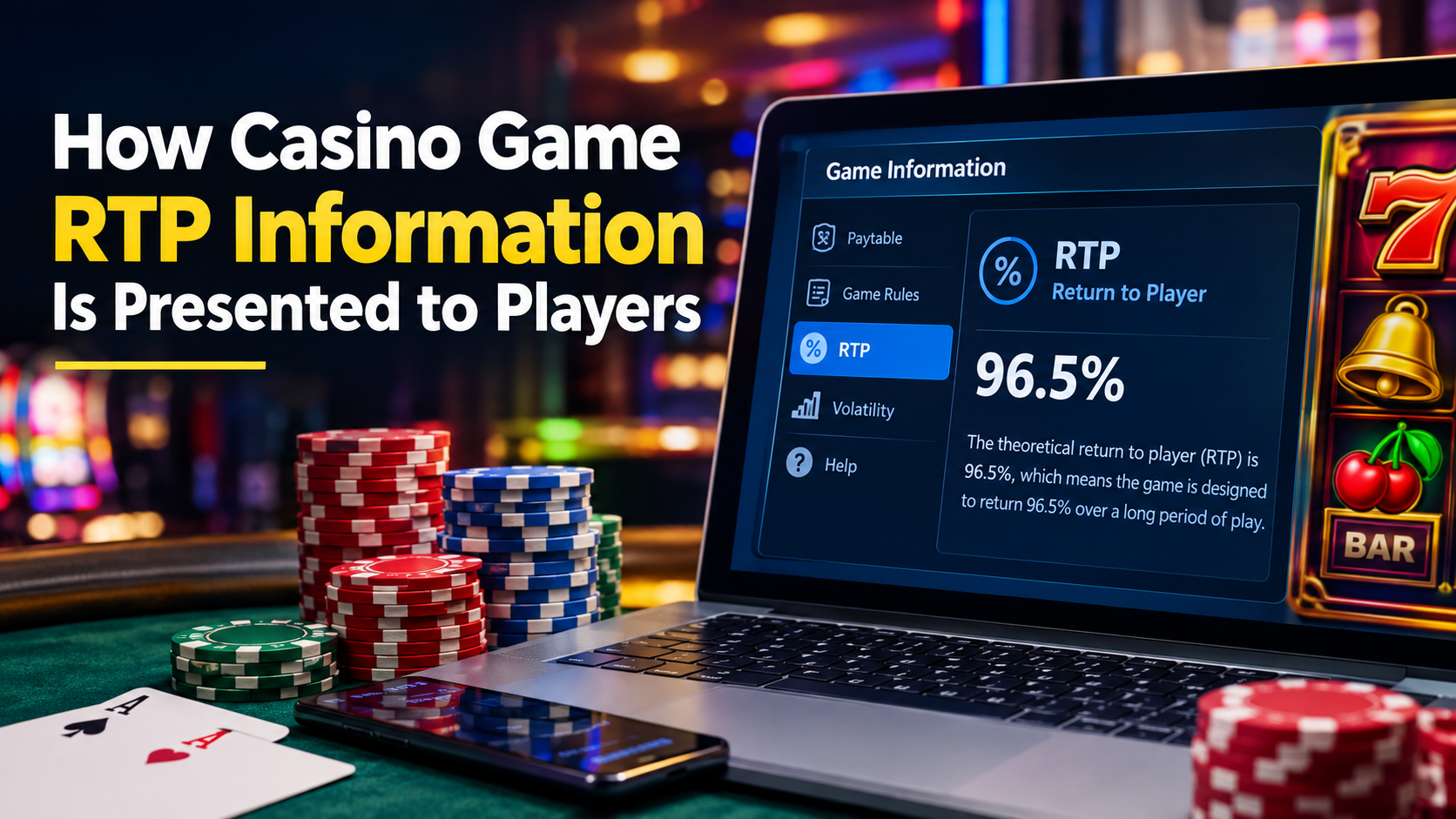
Online casino platforms generally place RTP information where players can access the game’s rules or information panel. The exact presentation depends on the software provider and platform design.
Common locations include:
- The game’s information or help button
- A “Paytable” or “Game Rules” section
- The game’s details page
- An information icon within the game interface
- A dedicated statistics or game-information panel
For physical gaming machines, RTP information may appear directly on the machine or within a software help screen. Regulatory guidance in the UK states that relevant gaming-machine information can be provided through a label, notice, or game help area.
This approach is useful because players should not have to search extensively to understand the basic mathematical characteristics of a game.
Why RTP Transparency Matters
Clear RTP information improves transparency. Players can compare games based on an objective mathematical characteristic instead of relying entirely on promotional descriptions or assumptions.
For example, if two slot-style games have similar themes and features but display different RTP percentages, that difference gives players additional information when deciding which game they want to explore.
However, RTP should never be considered a guarantee of profit. A higher theoretical RTP does not mean a player is more likely to win during a short session. The result of each individual game remains uncertain.
This distinction is particularly important for new players. A game with a 97% theoretical RTP can still produce a losing session, just as a player can experience a winning session on a game with a lower theoretical RTP.
RTP and Volatility Are Not the Same Thing
Another common mistake is treating RTP and volatility as interchangeable terms.
RTP describes the game’s theoretical long-term return, while volatility describes how frequently and how dramatically wins may occur. A lower-volatility game may produce smaller wins more regularly, while a higher-volatility game can involve less frequent but potentially larger outcomes.
The two concepts therefore provide different types of information.
The UK Gambling Commission describes volatility in terms of the variation around game outcomes, noting that highly volatile games can involve larger but less frequent prizes, while lower-volatility games may produce smaller and more frequent prizes.
Looking at both RTP and volatility can therefore give players a more complete understanding of a game’s mathematical profile.
How RTP Is Presented on Modern Casino Platforms
Modern casino interfaces increasingly aim to make game information accessible without interrupting the overall user experience. A player may be able to open the rules panel, review the paytable, and find the RTP percentage within a few clicks.
This is particularly useful on mobile devices, where screen space is limited. A well-designed interface can keep the main game screen simple while placing detailed information behind an easily identifiable information button.
Platforms covering multiple forms of online entertainment, including cricket, sports and casino categories, can also benefit from maintaining consistent information standards across their different sections. For users exploring a platform such as Cricbet99, straightforward navigation and clearly presented game information can make it easier to understand what is available before making any decisions.
Does a Higher RTP Guarantee Better Results?
No. RTP should always be viewed as a long-term theoretical figure rather than a short-term promise.
Suppose a game has a theoretical RTP of 96%. It does not mean every group of 100 spins will return exactly 96% of the amount wagered. Random outcomes can create significant variations over short periods.
The larger the number of plays considered, the more meaningful the theoretical RTP becomes. Even then, individual results can continue to vary.
This is why responsible players should avoid interpreting RTP as a personal return forecast.
What Should Players Check Besides RTP?
RTP is useful, but it should not be the only information players consider. Before playing, it can be sensible to check:
- Game rules: Understand how the game works and how prizes are awarded.
- Volatility: Consider whether the game’s win pattern suits your preferences.
- Minimum and maximum stakes: Know the available betting range.
- Bonus conditions: Read wagering or promotional terms carefully when applicable.
- Local rules: Gambling laws and availability can vary by location.
- Responsible-gaming tools: Set limits and avoid playing with money needed for essential expenses.
These details provide a more realistic picture than looking at an RTP percentage alone.
FAQs About Casino Game RTP
What is RTP in casino games?
RTP means Return to Player. It is a theoretical percentage representing the average amount a game is designed to return over a large number of plays.
Does 96% RTP mean I will get $96 back?
No. A 96% RTP is a long-term theoretical average. It does not guarantee a particular return during an individual session.
Is a higher RTP always better?
A higher RTP generally represents a lower theoretical house edge, but it does not guarantee better short-term results. Other factors, including volatility and game rules, also matter.
Where can I find RTP information?
RTP is commonly displayed in the game’s rules, paytable, information menu, or help section. The exact location depends on the game and platform.
Is RTP the same as volatility?
No. RTP relates to theoretical long-term return, while volatility describes how frequently and how significantly outcomes can vary.
Final Thought
RTP information gives players a useful way to understand the mathematical design of casino games, but it should always be interpreted correctly. It represents a long-term theoretical average, not a guaranteed result for an individual player.
The best approach is to read the available game information, understand RTP and volatility separately, review the rules, and treat casino gaming as entertainment rather than a guaranteed way to make money. Clear information and responsible decisions are ultimately more valuable than focusing on a single percentage.