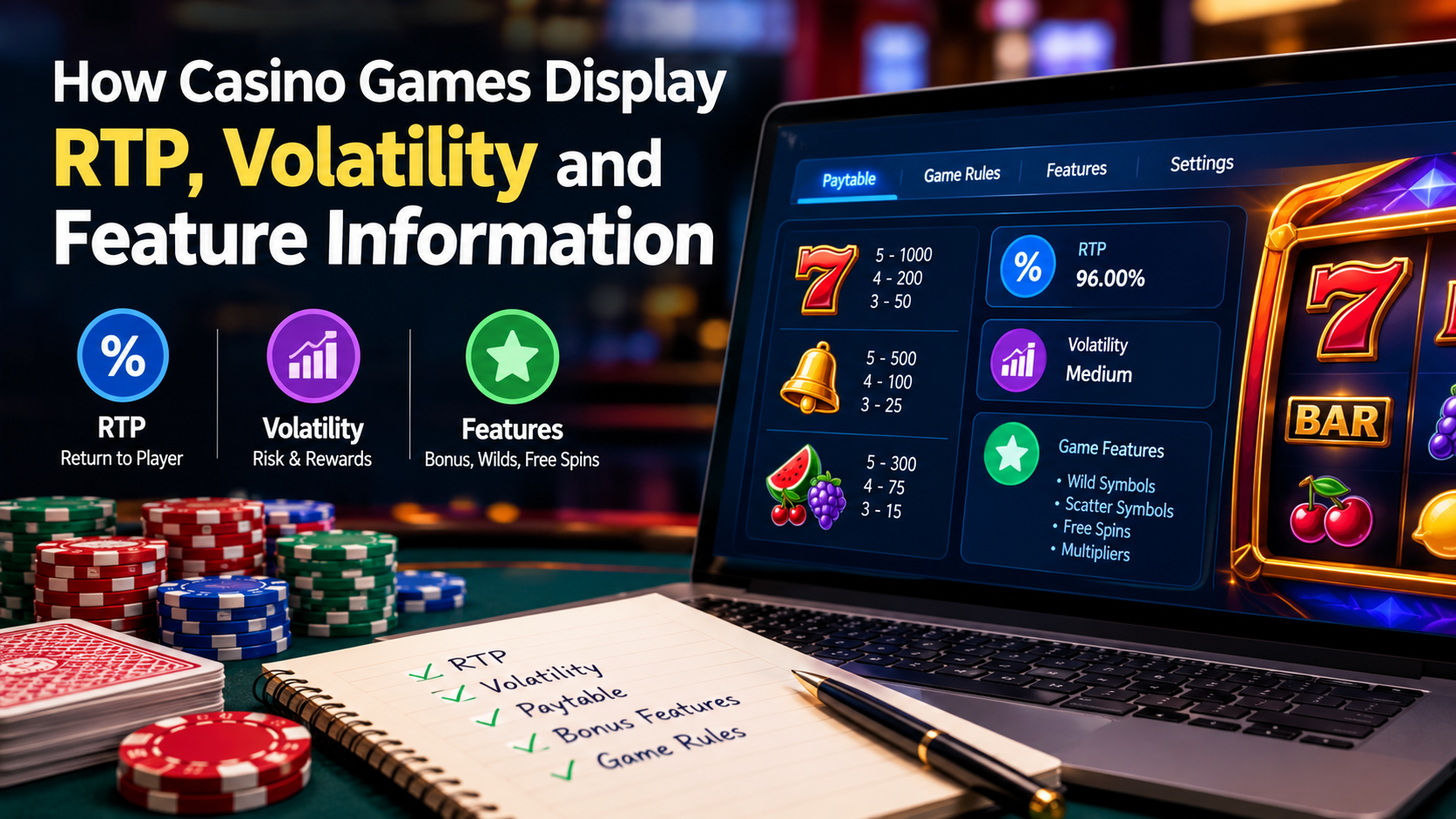
When choosing an online casino game, players often look beyond the theme, graphics, and jackpot size. The information shown inside a game can tell you much more about how it works. RTP, volatility, paytables, bonus features, paylines, and game rules are among the most useful details to check before playing.
These details are normally available through a game’s information, help, or settings section. However, they can sometimes be presented in different ways depending on the game provider and platform. Knowing what each term means makes it easier to understand the mathematical structure and features of a casino game.
What Is RTP in Casino Games?
RTP stands for Return to Player. It is a theoretical percentage that describes how much a game is designed to return over a very large number of plays.
For example, a game with a theoretical RTP of 96% is designed to return an average of $96 for every $100 wagered over a sufficiently large sample of play. This does not mean that a player will receive exactly 96% back during a single session.
The UK Gambling Commission explains that theoretical RTP is the designed return of a game, while actual RTP is calculated from the game’s real turnover and winnings over a particular period.
RTP information may appear as:
- RTP: 96.00%
- Return to Player: 96%
- Theoretical RTP: 96%
- Game rules or help-page information
Players should therefore look at the information panel rather than assuming that every game follows the same percentage.
How Is Volatility Displayed?
RTP tells you about the game’s long-term theoretical return, but it does not explain how frequently wins occur or how large those wins may be. That is where volatility becomes important.
Volatility describes the distribution and frequency of potential wins. A low-volatility game may produce smaller wins more frequently, while a high-volatility game may have larger but less frequent payouts. The Gambling Commission describes volatility using statistical measures such as standard deviation and notes the difference between smaller, more frequent prizes and larger, rarer prizes.
Game providers may display volatility in several ways, including:
- Low
- Medium
- High
- Very High
- Low / Medium / High indicators
- A numerical volatility rating
Not every casino game displays a formal volatility rating. In some cases, players may need to check the game’s official rules or provider information.
It is also important to remember that volatility does not predict the outcome of the next spin or hand. It describes the mathematical characteristics of the game rather than guaranteeing a particular result.
Where Do Players Find RTP and Volatility Information?
The location of game information varies between platforms. Common places include the Info, Help, Rules, or Paytable button.
In a slot game, for example, clicking the information icon may open several pages covering:
- RTP percentage
- Winning combinations
- Symbol values
- Wild and Scatter symbols
- Bonus rounds
- Free spins
- Jackpot rules
- Volatility or risk information
- Maximum potential win
- Game-specific terms
Some games show these details directly on the main screen, while others place them inside a separate menu.
This is why checking the information panel before playing is useful. It gives players a clearer picture of the game’s mechanics instead of relying only on its appearance or promotional description.
Understanding Paytables and Winning Symbols
The paytable is one of the most important sources of information in a casino game.
For slots, it normally explains how much each symbol can pay and how different combinations are formed. A paytable may also explain special symbols such as Wilds, Scatters, multipliers, bonus symbols, and expanding symbols.
For table games, the information can look different. A blackjack game may explain blackjack payouts, dealer rules, doubling options, splitting rules, and insurance. A baccarat game may display the available bets and their respective payouts.
For anyone comparing online casino games, reading the paytable can therefore be just as important as looking at the headline RTP.
How Feature Information Is Displayed
Modern casino games often include more than a basic win-and-lose mechanic. Developers use features to create different game experiences, and these features are generally explained inside the game’s information section.
Common examples include:
Wild Symbols
A Wild symbol may substitute for other symbols to help create winning combinations. However, the exact function varies from one game to another.
Scatter Symbols
Scatter symbols can activate free spins, bonus rounds, or other features without necessarily needing to appear on a standard payline.
Multipliers
A multiplier can increase the value of a qualifying win. The information panel should explain when and how the multiplier applies.
Free Spins
Free-spin features allow players to enter a separate bonus mode under the conditions defined by the game.
Progressive Jackpots
Some games are connected to jackpot systems where the potential prize can increase over time. Because jackpot prizes are typically infrequent and large, they can also contribute to higher volatility.
The important point is that a feature’s name alone does not explain its value. Players should check the actual rules attached to it.
RTP and Volatility Should Be Read Together
Looking at RTP without considering volatility can create an incomplete picture.
Two games can have similar theoretical RTP percentages while producing very different patterns of wins. One may have smaller and more frequent payouts, while another may rely on fewer but larger payouts.
For example, imagine two games that both advertise an RTP of 96%.
Game A: Lower volatility with smaller, more frequent wins.
Game B: Higher volatility with larger but less frequent wins.
The same RTP does not mean the games will feel identical during normal play. Short-term results can vary significantly because actual outcomes depend on the game’s random results and the number of plays.
The RTP figure itself is a long-term mathematical measurement, not a promise of a specific return during an individual session.
Why Game Rules Matter More Than Graphics
Casino games are often designed with strong visual themes, animations, sound effects, and interactive bonus rounds. These elements can make a game attractive, but they do not explain its mathematical structure.
Before playing, it is worth checking:
- The stated RTP
- Volatility information
- Paytable
- Minimum and maximum bet
- Maximum win, where provided
- Bonus-feature rules
- Special symbol functions
- Jackpot conditions
- Any applicable game-specific terms
This approach provides a more complete understanding of the game than judging it by graphics or advertised prizes alone.
Common Mistakes When Reading Casino Game Information
One common mistake is treating RTP as a guarantee. A 96% RTP does not mean that every $100 session will return $96.
Another mistake is assuming that a high-volatility game is automatically better because it can offer larger prizes. Volatility describes the distribution of outcomes; it does not guarantee a particular result.
Players can also overlook the paytable. A game may have several special symbols and bonus mechanics that significantly affect how it works.
Finally, previous results should not normally be treated as a prediction of the next independent outcome. Past spins or rounds do not automatically make a particular result “due.”
Frequently Asked Questions
What does RTP mean in casino games?
RTP means Return to Player. It is the theoretical percentage a game is designed to return over a very large number of plays. It does not predict the result of an individual session.
Is higher RTP the same as lower volatility?
No. RTP and volatility measure different aspects of a game. RTP concerns the theoretical long-term return, while volatility describes the distribution and frequency of wins.
Where can I find a game’s RTP?
RTP is commonly listed in the game’s information, rules, help, or paytable section. The exact location depends on the game and provider.
What does high volatility mean?
High volatility generally means that winning outcomes can be less frequent but potentially larger. It does not mean that a large win is guaranteed.
Do casino games show their features?
Most modern games provide information about features such as Wilds, Scatters, free spins, multipliers, bonus rounds, and jackpots through an information or paytable menu.
Does RTP guarantee that I will get my money back?
No. RTP is a theoretical long-term figure. Individual sessions can produce results that are significantly above or below the advertised RTP.
Final Thought
RTP, volatility, paytables, and feature descriptions give players a clearer understanding of what is happening behind the graphics of a casino game. RTP explains the game’s theoretical long-term return, volatility describes how wins may be distributed, while the paytable and rules explain the features that influence gameplay.
Taking a few moments to read this information can help set realistic expectations and reduce confusion about how a game works. If you’re comparing different casino titles, checking these details first is a more useful starting point than focusing only on themes, jackpots, or promotional claims.