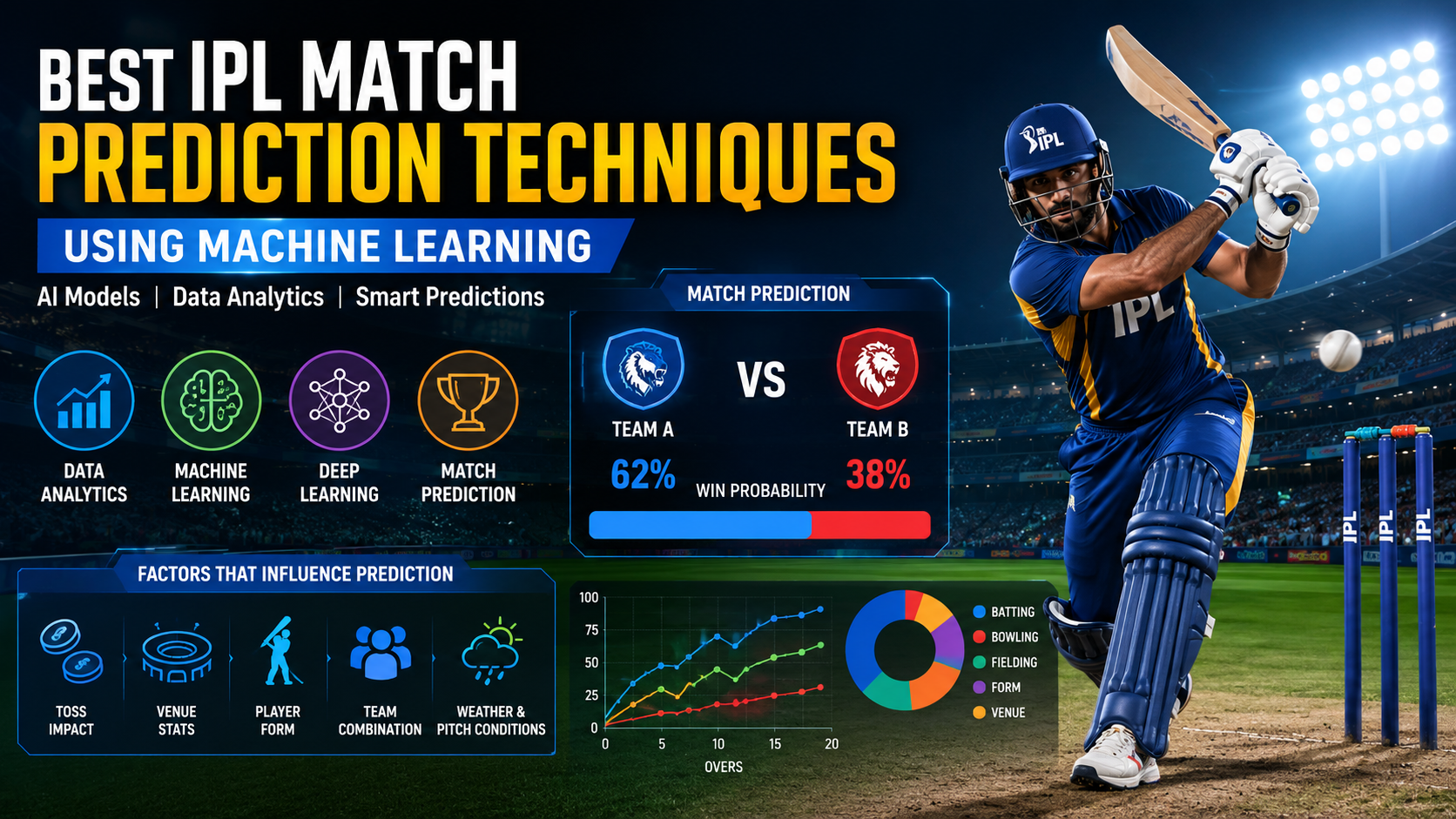
Best IPL Match Prediction Techniques Using Machine Learning
The popularity of the Indian Premier League has grown rapidly over the years, making IPL one of the most watched cricket tournaments in the world. Along with entertainment, IPL has also become a major area of interest for data analysts and machine learning experts. Today, many researchers use artificial intelligence and predictive models to forecast IPL match outcomes based on historical data, player statistics, pitch reports, toss results, and team performance.
Machine learning has completely changed the way cricket predictions are made. Instead of depending only on expert opinions, analysts now use algorithms that study previous match records and identify patterns to predict future outcomes. Several research papers and studies have explored different IPL match prediction techniques and compared their accuracy levels.
Why IPL Match Prediction is Important
IPL match prediction is useful for multiple reasons. Teams can improve their strategies, analysts can study player performance, and fans get a better understanding of match probabilities. Predictive systems are also widely used in fantasy cricket platforms where users rely on statistics to create winning teams.
The prediction process usually depends on factors such as:
- Team combinations
- Batting and bowling strength
- Venue records
- Toss advantage
- Player form
- Head-to-head statistics
- Pitch conditions
- Match pressure situations
Researchers have found that combining these factors with machine learning models increases prediction accuracy significantly.
Machine Learning Techniques Used in IPL Prediction
Different machine learning algorithms are used to predict IPL matches. Every technique works differently and produces varying levels of accuracy.
1. Random Forest Algorithm
Random Forest is considered one of the most effective techniques for IPL match prediction. It works by creating multiple decision trees and combining their outputs to generate the final prediction.
According to research studies, Random Forest provides higher accuracy because it can handle large cricket datasets and identify complex relationships between match factors. One study reported an accuracy of more than 88% using this model.
Advantages of Random Forest
- High prediction accuracy
- Handles large datasets efficiently
- Reduces overfitting issues
- Works well with multiple match parameters
Because of these benefits, Random Forest is widely preferred in sports analytics.
2. Logistic Regression
Logistic Regression is another commonly used technique in IPL prediction models. This algorithm predicts the probability of a team winning or losing based on input variables.
Researchers use Logistic Regression because it is simple, fast, and easy to interpret. It performs well when the dataset is balanced and organized properly.
Key Features
- Easy implementation
- Good for binary outcomes
- Fast processing speed
- Useful for basic prediction systems
Although it may not always outperform advanced models, it remains an important foundation for sports prediction analysis.
3. Support Vector Machine (SVM)
Support Vector Machine is a powerful supervised learning algorithm used in many IPL prediction systems. SVM separates winning and losing patterns using mathematical boundaries.
This technique performs well when the dataset contains complex relationships between variables. Researchers have used SVM to analyze toss decisions, batting order, and venue performance.
Benefits of SVM
- Effective for classification tasks
- Handles high-dimensional data
- Works well with structured cricket datasets
However, SVM may require more computational power compared to simpler algorithms.
4. K-Nearest Neighbor (KNN)
K-Nearest Neighbor predicts match outcomes by comparing current match conditions with previously played matches. The model identifies similar historical situations and predicts results accordingly.
KNN is mainly useful for smaller datasets and beginner-level prediction systems.
Advantages
- Simple to understand
- Easy implementation
- Effective for pattern matching
The major limitation is that prediction speed becomes slower when the dataset grows larger.
5. Deep Learning Models
Deep learning is one of the most advanced IPL prediction techniques. It uses artificial neural networks to analyze large amounts of cricket data and identify hidden patterns.
Deep learning models can process ball-by-ball data, player performance trends, and live match situations more effectively than traditional methods. Many modern IPL score prediction systems use deep learning because of its ability to improve continuously with more data.
Why Deep Learning is Powerful
- Handles massive datasets
- Learns complex cricket patterns
- Improves prediction quality over time
- Useful for live score prediction
Despite its advantages, deep learning requires high-quality datasets and strong computational resources.
Important Factors That Improve IPL Predictions
Machine learning models become more accurate when they include important match-related factors. Researchers have identified several key elements that strongly influence IPL results.
Toss Impact
Winning the toss can affect match outcomes, especially on pitches where chasing becomes easier.
Venue Statistics
Some teams perform exceptionally well on specific grounds due to pitch familiarity and crowd support.
Player Form
Recent batting and bowling performances greatly influence predictions.
Team Combination
Balanced teams with strong all-rounders generally perform better in pressure situations.
Weather and Pitch Conditions
Dew, humidity, and pitch behavior can change match dynamics significantly.
Combining all these features helps machine learning models generate better predictions.
Challenges in IPL Match Prediction
Even advanced machine learning models face difficulties while predicting cricket matches because cricket is highly unpredictable.
Some common challenges include:
- Sudden player injuries
- Unexpected batting collapses
- Rain interruptions
- Pressure handling during close matches
- Individual brilliance from players
These unpredictable moments make cricket one of the hardest sports for accurate forecasting.
Future of IPL Prediction Using AI
The future of IPL prediction looks very promising with the growth of artificial intelligence and data analytics. Modern systems are now capable of processing live match data in real time and generating instant predictions.
Future technologies may include:
- Real-time AI prediction engines
- Advanced player fitness analysis
- Ball tracking integration
- Smart fantasy cricket recommendations
- Predictive analytics for team management
As machine learning continues to evolve, prediction systems are expected to become faster and more accurate.
FAQs
Which machine learning algorithm is best for IPL prediction?
Random Forest is considered one of the best algorithms because it provides high accuracy and handles complex cricket datasets effectively.
Can AI predict IPL matches accurately?
AI can predict match outcomes with good accuracy, but cricket remains unpredictable due to sudden match-changing events.
What factors are important in IPL prediction?
Important factors include toss result, venue, player form, batting strength, bowling attack, and previous team performance.
Is deep learning better than traditional machine learning?
Deep learning performs better with large datasets and live data analysis, but it requires more computing power and training data.
Why is IPL prediction difficult?
Cricket matches can change quickly because of player pressure, weather conditions, injuries, and unexpected performances.
Final Thoughts
IPL match prediction has become an exciting combination of cricket and technology. Machine learning algorithms like Random Forest, Logistic Regression, SVM, KNN, and Deep Learning have improved the accuracy of match forecasting significantly. These techniques analyze historical records, player performance, venue statistics, and match conditions to generate smart predictions.
Although no prediction model can guarantee perfect results, modern AI systems have made IPL analysis more scientific and data-driven. As technology continues to grow, IPL prediction models will become even more advanced, helping teams, analysts, fantasy players, and cricket fans make smarter decisions.