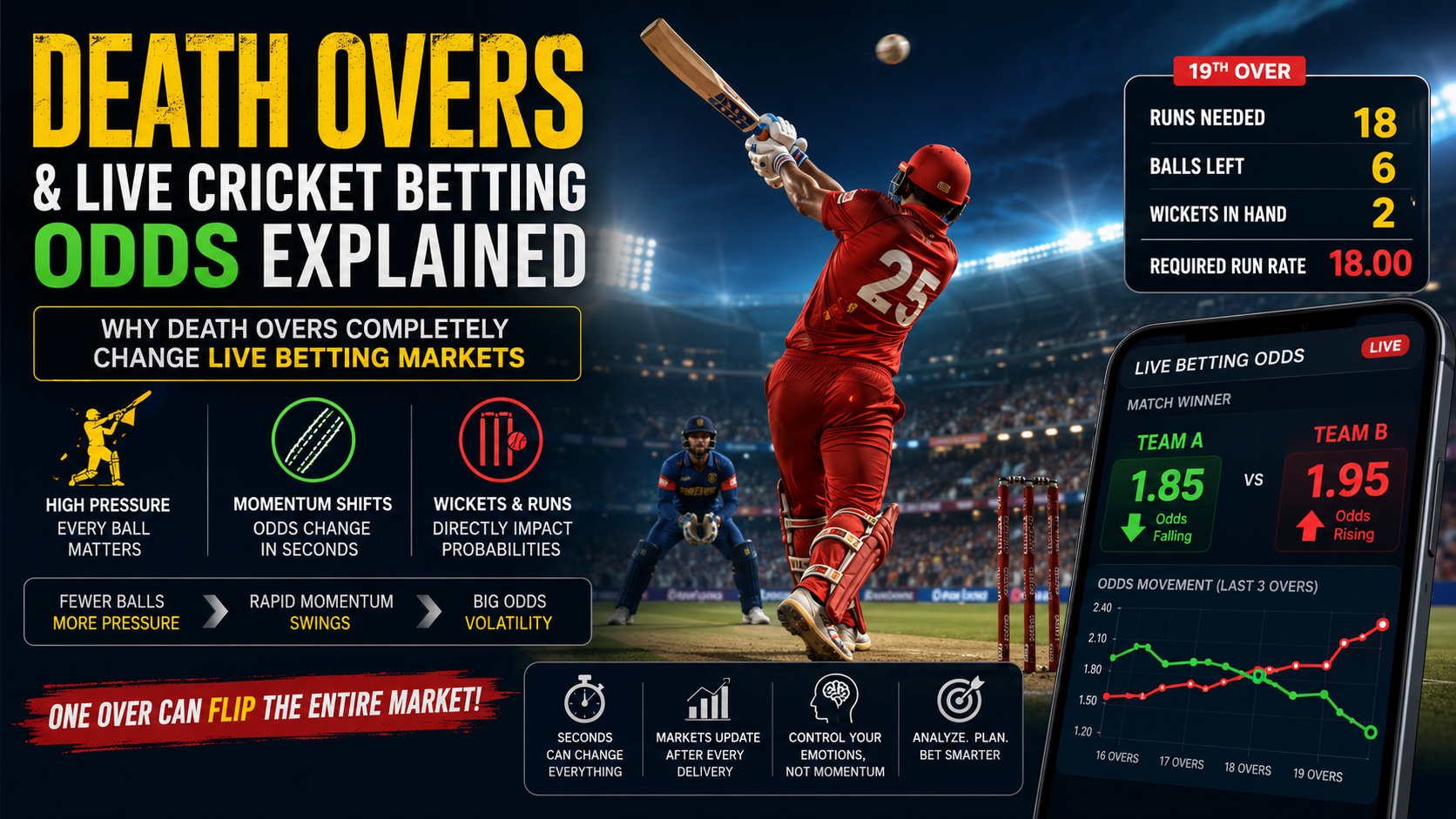
Why Death Overs Completely Change Live Cricket Betting Markets
Live cricket betting is not just about predicting who will win a match — it is about understanding how probabilities shift every few seconds. Among all phases of a cricket match, the death overs (usually overs 16–20 in T20 cricket) create the most extreme and fastest changes in live betting odds.
This is not random. It is driven by structure, pressure, and mathematics.
Why Death Overs Are the Most Volatile Phase
Death overs are the final stretch where teams either explode the scoring rate or collapse under pressure. At this stage, the required runs are usually high, and every ball carries maximum importance.
Unlike the early overs where the game builds slowly, death overs are defined by:
- Maximum attacking intent from batters
- Risk-heavy bowling strategies (yorkers, slower balls)
- Field restrictions optimized for saving boundaries
- Constant win/loss probability swings
Because of this, even a single ball can completely reshape the match narrative — which directly impacts odds movement in live markets.
Research and betting analysis consistently show that T20 cricket is already the most volatile format, and the death overs amplify this volatility even further due to compressed decision-making windows and high run pressure.
How One Over Can Flip the Entire Market
In live betting, odds are constantly recalculated based on real-time match data like required run rate, wickets, and momentum.
During death overs:
- A single six can instantly drop odds on the chasing team
- A dot-ball over can double pressure and swing probability the other way
- A wicket often triggers the sharpest odds spike of the entire match
Market systems react instantly because the statistical outcome changes drastically with each delivery.
For example:
- 18 runs needed off 12 balls → balanced market
- One wicket → required rate spikes → odds shift sharply
- Two boundaries → odds collapse again
These rapid recalculations create what traders call a “live momentum loop”, where every ball resets expectations.
Why Death Overs Cause Bigger Odds Swings Than Powerplay
Powerplay overs (1–6) also influence odds, but death overs dominate volatility for one key reason:
Time compression effect
At the start of the innings, teams still have:
- wickets in hand
- time to recover
- stable match structure
But in death overs:
- very few balls remain
- risk is mandatory, not optional
- every mistake is final
This “no-recovery zone” makes probability curves extremely sensitive.
Even models used by bookmakers struggle here because:
- player decisions are unpredictable
- execution pressure changes shot selection
- bowlers rely on variations, not consistency
That is why odds can swing dramatically within seconds.
Momentum vs Reality: Why Markets React So Fast
Live betting markets are not just reacting to scoreboards — they are reacting to perceived momentum.
During death overs:
- Two boundaries = perceived dominance
- One wicket = perceived collapse
- One tight over = perceived control shift
But momentum is often emotional, while pricing models are mathematical. This mismatch creates fast adjustments and sometimes overreactions.
Sharp odds movements usually happen when:
- key batters are dismissed
- scoring spikes unexpectedly
- required run rate suddenly changes
These are not emotional reactions alone — they are automated probability recalculations based on updated match states.
Liquidity and the Speed of Odds Changes
Another major factor is market liquidity (how much money is flowing in the market).
In big matches (IPL, internationals):
- odds adjust smoothly but still rapidly
- large bets are absorbed quickly
In smaller matches:
- even small events cause huge odds jumps
- markets are less stable
During death overs, liquidity meets extreme uncertainty, which creates the fastest price movements in the entire match.
Psychological Impact on Betting Behavior
Death overs don’t just change numbers — they change human decision-making.
Common patterns include:
- chasing losses after a boundary
- overreacting to one wicket
- assuming momentum will continue indefinitely
- making decisions in seconds instead of analysis
This is why many live betting errors happen specifically in the final overs — not because information is missing, but because reaction time is too short to think clearly.
Why Death Overs Are Called “Market Shock Zones”
In betting analytics, death overs are often described as shock zones because:
- probability models update every ball
- uncertainty is at its peak
- emotional reactions peak among bettors
- execution errors directly decide outcomes
A match that looks stable at 16 overs can completely reverse by the 19th over.
That is why sportsbooks see the highest volatility and most rapid odds recalibration in this phase.
Final Thoughts
Death overs are the most important phase in live cricket betting because they compress the entire match outcome into a few high-pressure deliveries.
This creates a unique environment where:
- probabilities shift instantly
- momentum is unpredictable
- markets react faster than perception
- and every ball has “match-defining” weight
In simple terms, death overs are where cricket stops being gradual and becomes instantaneous mathematics — and that is exactly why live betting markets change so dramatically during this phase.
FAQs
1. Why do death overs affect live betting odds so much?
Death overs have very few balls left and high run pressure, so even one boundary or wicket can drastically change the match outcome probability. This makes odds shift much faster compared to earlier overs.
2. Are live betting odds more accurate in death overs?
They are updated more frequently, but not always “more accurate.” The uncertainty is actually higher because player decisions, pressure, and execution become unpredictable in the final overs.
3. Why do odds change instantly after a single ball in death overs?
Because live betting models constantly recalculate win probability based on:
- Remaining runs
- Balls left
- Wickets in hand
A single ball can significantly change all three factors at once.
4. Which matters more in death overs — wickets or runs?
Both matter, but wickets usually have a stronger impact on odds. Losing a set batter reduces scoring potential and increases required run pressure immediately.
5. Why do bettors lose more money in death overs?
Because decisions are often emotional and rushed. Many bettors overreact to:
- One six
- One wicket
- One tight over
This leads to poor timing in placing bets.
6. Can momentum be trusted in live betting during death overs?
Momentum can be misleading. A couple of boundaries may look dominant, but one wicket can completely reverse the situation. That’s why markets rely more on numbers than perception.
7. Why are death overs called “high volatility zones”?
Because:
- Match outcome changes rapidly
- Risk level is highest
- Every ball has high impact
- Odds fluctuate within seconds
8. Do all cricket formats behave the same in death overs betting?
No. T20 cricket shows the highest volatility, followed by ODI cricket. Test matches are much more stable and less sensitive to short-term events.
9. What is the biggest mistake bettors make in death overs?
The biggest mistake is chasing momentum instead of analyzing remaining runs, balls, and wickets objectively. Emotional betting leads to poor decisions in this phase.
10. Why do bookmakers adjust odds so fast in death overs?
Because risk exposure changes instantly. Bookmakers must rebalance probabilities after every ball to avoid heavy losses due to sudden match swings.