England vs South Africa Women’s T20 World Cup Semi-Final: Key Battles That Decided the Match
England vs South Africa Women’s T20 World Cup Semi-Final: Key Battles That Decided the Match
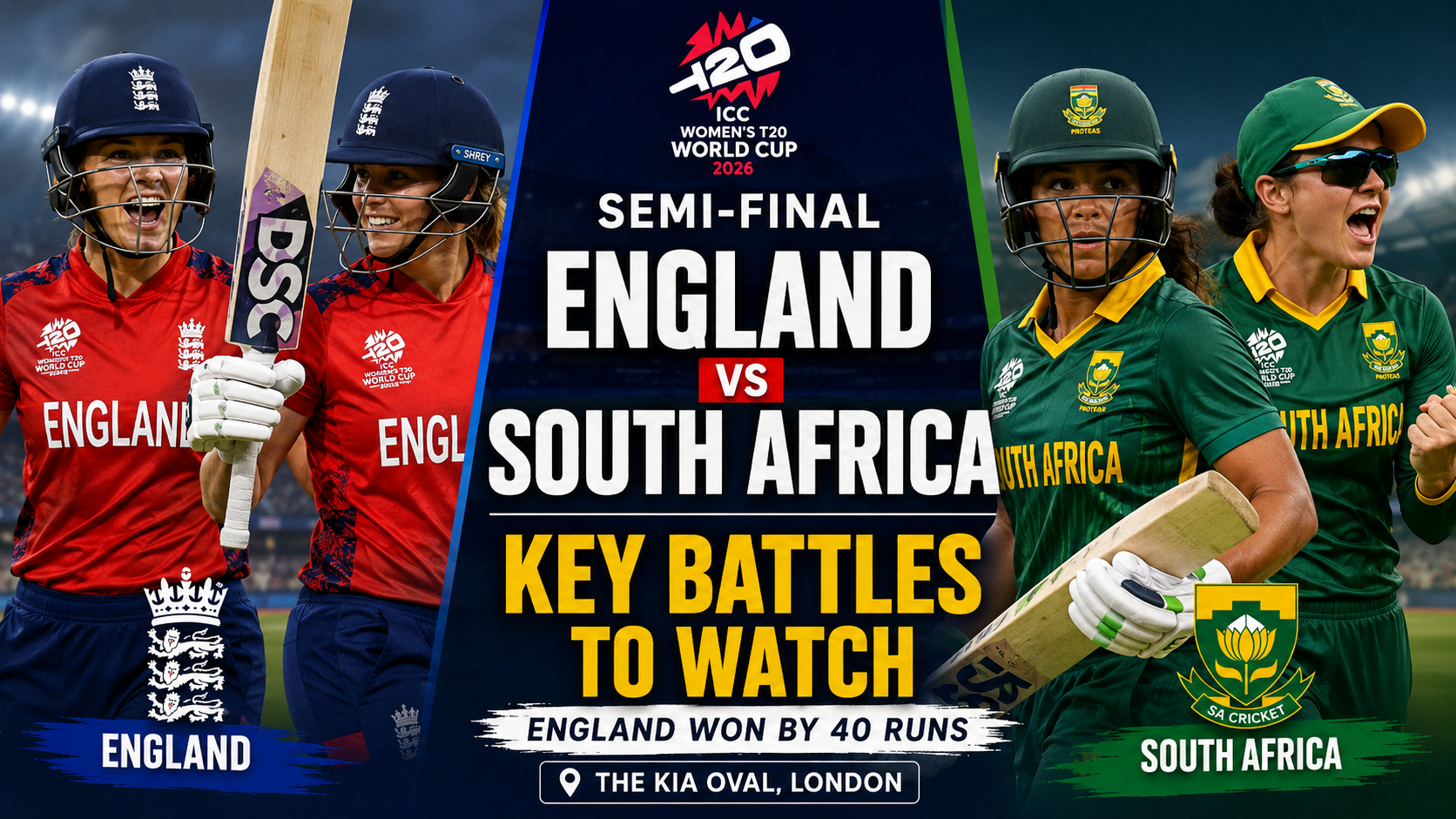
The ICC Women’s T20 World Cup 2026 semi-final between England and South Africa promised a thrilling contest, and it delivered plenty of memorable moments. Played at The Kia Oval in London, the match showcased high-quality cricket, tactical brilliance, and individual performances that ultimately helped England secure a convincing 40-run victory. England recovered brilliantly after an early collapse before their bowlers produced a disciplined performance to book a place in the final.
While the final scoreline suggests a comfortable win, the contest was shaped by several crucial player battles that influenced the momentum throughout the game. From England’s middle-order rescue act to South Africa’s struggle against disciplined bowling, every phase featured key moments that decided the outcome.
England’s Recovery After an Early Collapse
England’s innings could not have started much worse. Losing three wickets for just 23 runs handed South Africa early control of the match. Fast bowlers applied excellent pressure with disciplined lines, forcing England onto the back foot.
However, experienced campaigners Nat Sciver-Brunt and Heather Knight responded with remarkable composure. Instead of chasing boundaries immediately, they focused on rebuilding the innings through smart running between the wickets and calculated stroke play.
Their partnership completely changed the complexion of the match. Once the pressure eased, both batters accelerated, allowing England to post a competitive total of 169/5 after recovering from a dangerous position. Their 133-run stand proved to be the defining partnership of the semi-final.
Key Battle 1: Nat Sciver-Brunt vs South Africa’s Pace Attack
One of the biggest contests heading into the game involved England captain Nat Sciver-Brunt facing South Africa’s experienced fast bowlers.
Returning after recovering from injury, Sciver-Brunt showed exactly why she remains one of the world’s premier all-rounders. Initially cautious against the new ball, she gradually began finding gaps before punishing loose deliveries.
South Africa attempted short balls, slower deliveries, and attacking fields, but Sciver-Brunt adapted brilliantly. Her unbeaten confidence after the early wickets helped England regain control, and her 75-run innings became the foundation of England’s winning total.
Key Battle 2: Heather Knight’s Experience vs South Africa’s Spin
Heather Knight played the perfect supporting role while also keeping the scoreboard moving.
South Africa introduced spin during the middle overs in an attempt to break the partnership. Knight countered with intelligent footwork and excellent strike rotation, ensuring England never lost momentum.
Rather than taking unnecessary risks, she consistently found singles and punished bad deliveries. Her calm approach frustrated South Africa’s bowlers and prevented them from building sustained pressure.
The combination of Knight’s experience and Sciver-Brunt’s aggression made England’s middle overs highly productive.
Key Battle 3: England’s Bowling vs Tazmin Brits
South Africa needed a strong start while chasing 170, and Tazmin Brits looked determined to provide exactly that.
Brits played positively during the powerplay, timing the ball well and finding boundaries. However, England’s bowlers refused to panic.
Instead of attacking with only pace, England mixed lengths intelligently and kept changing angles. Their disciplined bowling prevented South Africa from maintaining the required run rate even while wickets remained in hand.
Although Brits reached a fighting half-century, England successfully ensured that her innings never became match-winning.
Key Battle 4: Sophie Ecclestone and Charlie Dean Control the Middle Overs
Every successful T20 chase depends on dominating the middle overs.
England’s spin duo of Sophie Ecclestone and Charlie Dean produced exactly that.
Rather than searching for magical deliveries, both bowlers focused on consistency. They forced South Africa’s batters to take risks, dried up boundaries, and increased the required run rate.
The pressure eventually resulted in crucial wickets, shifting the match firmly towards England.
Their economical spells highlighted why England’s bowling attack remains one of the strongest in international women’s cricket.
Fielding Made the Difference
Beyond batting and bowling, England’s fielding standards stood out throughout the contest.
Sharp catches, athletic boundary saves, and quick ground fielding prevented South Africa from stealing easy runs.
Modern T20 cricket is often decided by small margins, and England consistently won those moments.
Several well-executed run-saving efforts added pressure that eventually forced South Africa into mistakes.
Why England Dominated the Semi-Final
England’s victory wasn’t built on one outstanding performance alone.
Instead, it reflected a complete team effort.
The major reasons behind England’s success included:
- Recovering brilliantly after losing three early wickets.
- A record-changing partnership between Nat Sciver-Brunt and Heather Knight.
- Disciplined bowling during South Africa’s chase.
- Outstanding fielding throughout the innings.
- Better execution under knockout pressure.
These factors combined to produce one of England’s most complete performances of the tournament.
What South Africa Can Learn
Despite the defeat, South Africa once again demonstrated why they remain among the strongest teams in women’s cricket.
Their bowlers created early opportunities and controlled the powerplay effectively.
However, failing to break the Sciver-Brunt–Knight partnership allowed England to rebuild completely. During the chase, South Africa also struggled to maintain momentum after losing wickets in the middle overs.
Improving middle-order consistency and converting pressure into wickets will remain important areas as they prepare for future ICC tournaments.
Final Thought
England’s 40-run victory over South Africa was a textbook example of how championship teams respond under pressure. After a difficult start, experienced players stepped up when it mattered most, while the bowling unit defended the target with discipline and confidence.
The semi-final demonstrated that knockout cricket is rarely decided by explosive starts alone. Smart partnerships, tactical bowling changes, disciplined fielding, and composure during pressure situations ultimately separated the two sides.
With momentum firmly on their side, England earned their place in the Women’s T20 World Cup final through a complete all-round performance that showcased both experience and resilience.
FAQs
1. Who won the England vs South Africa Women’s T20 World Cup 2026 semi-final?
England defeated South Africa by 40 runs at The Kia Oval to qualify for the ICC Women’s T20 World Cup 2026 final.
2. Who was the top scorer for England?
Nat Sciver-Brunt led England’s batting with an outstanding 75 runs, while Heather Knight contributed a valuable 58.
3. What was the turning point of the match?
The 133-run partnership between Nat Sciver-Brunt and Heather Knight completely changed the momentum after England had slipped to 23/3.
4. Why couldn’t South Africa chase the target?
England’s disciplined bowling, tight fielding, and pressure during the middle overs prevented South Africa from maintaining the required run rate.
5. Who will England face in the Women’s T20 World Cup 2026 final?
England advanced to face Australia in the ICC Women’s T20 World Cup 2026 final.