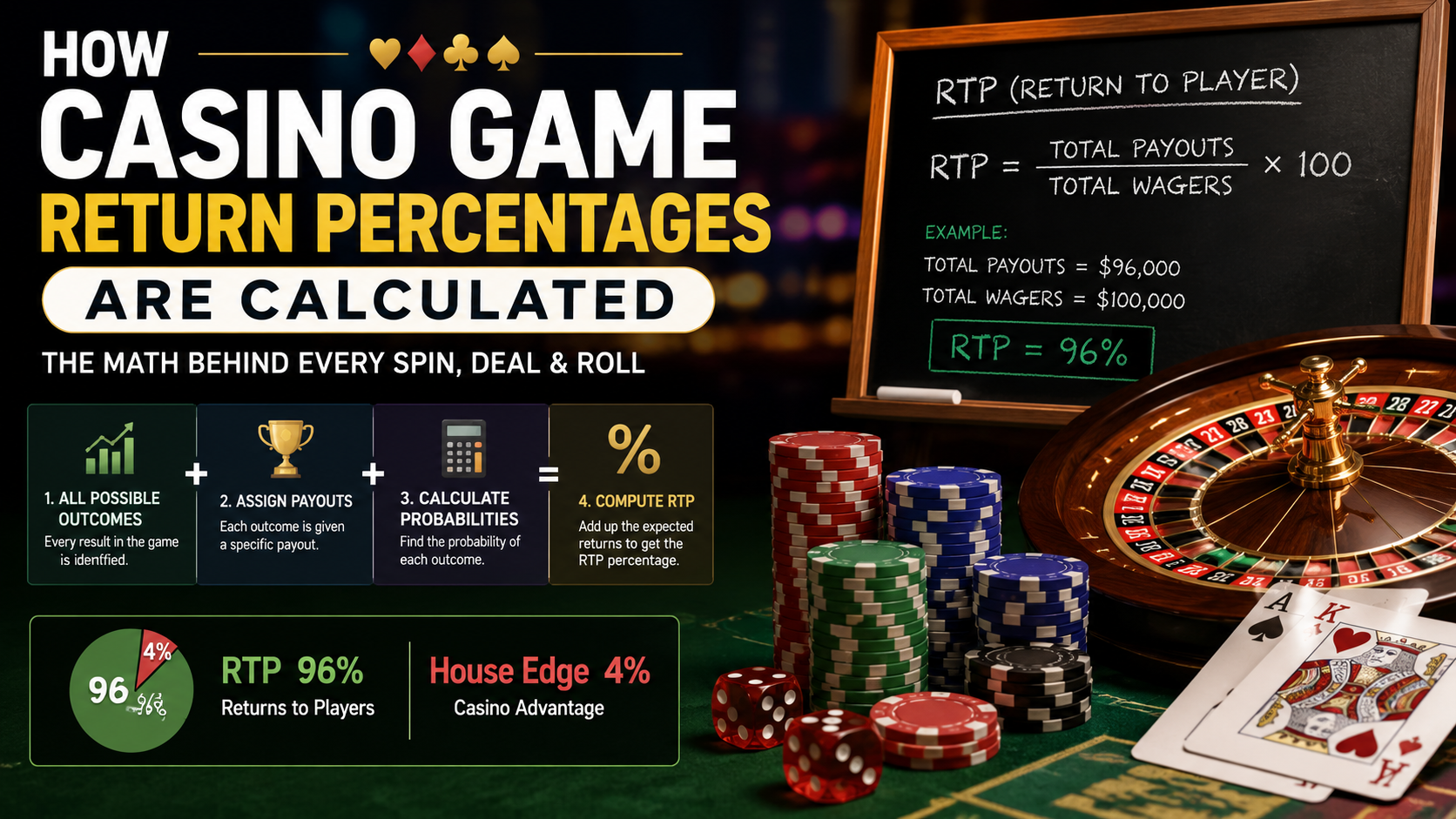
Online casino games may look simple on the surface, but every spin, card, or dice roll is backed by carefully designed mathematics. One of the most important concepts behind every casino game is the Return to Player (RTP) percentage. While many players notice this number in game information, few understand how it is actually calculated or what it means in real-world gameplay.
Knowing how RTP works helps players set realistic expectations and make informed decisions when choosing casino games. Instead of chasing unrealistic winning strategies, understanding return percentages provides a better picture of how casino games are designed over the long term.
What Is Return to Player (RTP)?
Return to Player, commonly known as RTP, is the theoretical percentage of all wagered money that a casino game is expected to return to players over an extremely large number of rounds.
For example, if a slot game has an RTP of 96%, it means that, in theory, the game returns $96 for every $100 wagered over millions of spins. The remaining 4% represents the casino’s mathematical advantage, also known as the house edge.
It is important to remember that RTP is not a guarantee for individual gaming sessions. A player could win much more than the RTP suggests or lose their entire bankroll during a short session. RTP only becomes meaningful when considering millions of game outcomes.
How Developers Calculate RTP
Casino game developers calculate RTP during the game design process using advanced mathematical models and probability analysis.
The calculation generally follows these steps:
1. Define Every Possible Outcome
Every casino game has a fixed set of possible outcomes.
For example:
- Slot games have symbol combinations.
- Roulette has numbered pockets.
- Blackjack follows card probabilities.
- Baccarat uses predefined card rules.
Developers identify every possible result before assigning payouts.
2. Assign Payout Values
Each winning outcome receives a payout amount.
For instance, if a certain symbol combination appears once every 500 spins and pays 450x the bet, developers include that payout in the mathematical model.
3. Calculate Expected Return
Using probability formulas, developers multiply the probability of each winning outcome by its payout.
The expected returns from all winning combinations are then added together to determine the overall RTP.
A simplified example looks like this:
Expected Return = Probability × Prize
Repeating this calculation for every possible outcome produces the game’s theoretical return percentage.
Why RTP Is Theoretical Rather Than Guaranteed
Many new players assume that playing long enough guarantees the published RTP. This is one of the biggest misconceptions in casino gaming.
Individual sessions are influenced by short-term variance. A player may experience:
- Several large wins within minutes
- Long losing streaks
- Break-even sessions
- Unexpected jackpot wins
Because outcomes are generated independently, short-term results rarely match the published RTP exactly.
The RTP reflects millions of simulated or actual game rounds—not a single evening of play.
The Relationship Between RTP and House Edge
RTP and house edge always add up to 100%.
For example:
| RTP | House Edge |
| 98% | 2% |
| 96.5% | 3.5% |
| 95% | 5% |
A higher RTP generally means a lower mathematical advantage for the casino.
However, RTP alone should never be the only factor when selecting a game.
RTP vs Volatility
Many players confuse RTP with volatility, but they measure completely different things.
RTP describes how much money is expected to return over time.
Volatility describes how frequently and how much a game tends to pay.
For example:
- High RTP + High Volatility = Bigger but less frequent wins.
- High RTP + Low Volatility = Smaller but more consistent payouts.
Understanding both metrics provides a much clearer picture of a game’s behavior.
Do Live Casino Games Have RTP?
Yes.
Live dealer games also have theoretical return percentages because their rules are fixed.
Examples include:
- European Roulette
- Baccarat
- Blackjack
- Sic Bo
Although live games involve physical cards or roulette wheels, the mathematical probabilities remain consistent over the long run.
Why Independent Testing Matters
Before licensed casino games reach players, they are often tested by independent laboratories.
Organizations such as eCOGRA verify that games perform according to their advertised RTP and meet fairness standards. Independent testing helps ensure that certified games produce outcomes consistent with their mathematical design.
Choosing Casino Games Wisely
While RTP is an important statistic, experienced players also consider game variety, volatility, betting limits, bonus features, and overall gameplay experience.
If you’re interested in learning more about online casino games, gaming strategies, and industry insights, explore the online casino guide available on CricBet99, where you’ll find beginner-friendly resources and updated information about popular casino games.
Taking time to understand how different games work is often more valuable than relying on myths or chasing impossible winning systems.
Common Misconceptions About RTP
“A game is due for a win.”
Every spin or round is independent. Previous outcomes do not influence future results.
“Higher RTP guarantees profit.”
A higher RTP simply means better theoretical returns over millions of rounds—not guaranteed winnings.
“Casinos can change RTP whenever they want.”
Licensed casinos cannot arbitrarily alter certified games without following regulatory requirements. Any RTP configuration is determined by the game provider and applicable licensing rules.
FAQs
What is considered a good RTP?
Generally, an RTP of 96% or higher is viewed as competitive for many online casino games. However, game enjoyment and volatility are also important considerations.
Does RTP apply to every gaming session?
No. RTP represents theoretical long-term performance across millions of game rounds rather than individual sessions.
Is RTP the same for all casinos?
If the same certified game version is offered, the RTP is usually identical. However, some providers release multiple RTP configurations depending on the casino operator.
Can RTP predict my next win?
No. Every game outcome is independent, and RTP cannot predict future results.
Why do players still lose on high-RTP games?
Short-term variance can produce winning or losing streaks regardless of the game’s long-term mathematical return.
Final Thoughts
Casino game return percentages are based on probability, mathematics, and extensive testing—not luck or hidden formulas. RTP serves as a valuable tool for understanding how games are designed over the long term, but it should never be mistaken for a promise of individual success.
Players who understand the difference between RTP, volatility, and house edge are better equipped to choose games that match their preferences and expectations. Rather than focusing solely on chasing wins, learning how casino mechanics work leads to a more informed and enjoyable gaming experience.