How RTP Works in Online Slots: A Complete Guide for Smarter Play
If you’ve ever explored online slot games, you’ve probably noticed a percentage called RTP, or Return to Player. While many players see this number listed in a game’s information, not everyone understands what it actually means or how it affects gameplay.
Understanding how RTP works in online slots can help you make more informed decisions when choosing games. Although RTP does not guarantee winnings, it provides valuable insight into a slot’s long-term payout potential.
In this guide, we’ll explain RTP in simple terms, discuss why it matters, clear up common misconceptions, and show you how to use RTP as one factor in selecting online slot games.
What Is RTP in Online Slots?
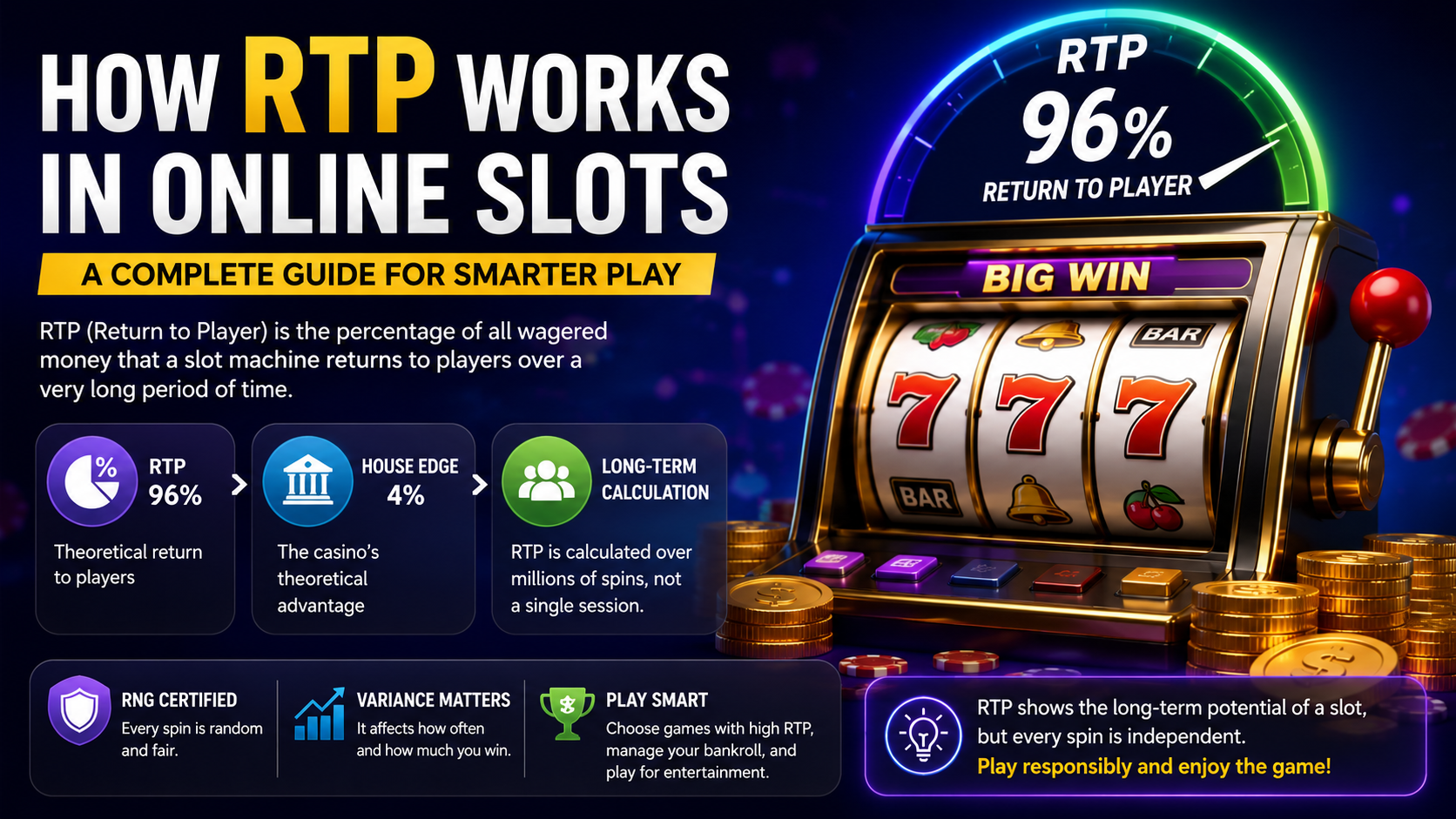
RTP (Return to Player) is the theoretical percentage of all wagered money that a slot machine is expected to return to players over a very large number of spins.
For example:
- A slot with an RTP of 96% theoretically returns $96 for every $100 wagered over millions of spins.
- The remaining 4% represents the casino’s theoretical advantage, commonly known as the house edge.
It’s important to understand that RTP is calculated over an extremely long period. It does not predict what will happen during a single session or even over hundreds of spins.
How RTP Actually Works
Every online slot uses a Random Number Generator (RNG) to determine the outcome of every spin.
The RNG continuously generates random numbers, ensuring that:
- Every spin is independent.
- Previous outcomes do not influence future spins.
- There are no “due” wins.
- Results cannot be predicted.
The RTP percentage is built into the game’s mathematical design. Game developers test millions—or even billions—of simulated spins to calculate the theoretical return.
For example:
Imagine a slot with:
- RTP: 96.5%
- House Edge: 3.5%
After millions of simulated wagers totaling $10 million, the game would theoretically return around $9.65 million to players.
Individual players, however, may experience results that differ significantly due to short-term variance.
RTP vs House Edge
Many people confuse RTP with the house edge, but they’re simply opposite sides of the same calculation.
| RTP | House Edge |
| Money returned to players over time | Casino’s theoretical advantage |
| Higher is generally better | Lower is generally better |
| Example: 96% | Example: 4% |
A simple formula:
House Edge = 100% − RTP
So if a game has:
- RTP: 97%
- House Edge: 3%
Both figures describe the same mathematical relationship from different perspectives.
Why RTP Matters
While RTP doesn’t guarantee wins, it helps players compare games objectively.
Generally speaking:
- Higher RTP slots return more money over the long run.
- Lower RTP games retain more money for the casino.
- RTP can be useful when deciding between similar slot games.
For example:
| RTP | Long-Term Theoretical Return |
| 94% | Lower |
| 96% | Average |
| 97%+ | Higher |
Many experienced players prefer slots with RTP values above 96%, although RTP should never be the only factor considered.
RTP Does Not Guarantee Short-Term Results
One of the biggest misunderstandings is believing that a high RTP means you’ll win more during today’s session.
That’s not how RTP works.
Consider these examples:
Player A:
- Plays 20 spins.
- Hits a large bonus feature.
- Finishes with a profit.
Player B:
- Plays the exact same slot.
- Completes 500 spins.
- Ends with a loss.
Both outcomes are completely possible because slot games rely on randomness.
RTP only becomes meaningful across an enormous number of spins—not during a single visit to an online casino.
Volatility Matters Too
Another important concept is volatility (also called variance).
While RTP tells you how much a game theoretically returns, volatility suggests how those returns may be distributed.
Low Volatility
- Smaller wins
- More frequent payouts
- Lower fluctuations
Medium Volatility
- Balanced gameplay
- Moderate payouts
- Average risk
High Volatility
- Less frequent wins
- Larger potential payouts
- Higher risk
Two slots may both have a 96.5% RTP, yet deliver completely different playing experiences because of their volatility.
Where to Find RTP Information
Most licensed online casinos display RTP in the game’s information section.
You can usually find it by:
- Opening the game’s Help menu
- Viewing the Paytable
- Checking the Information icon
- Visiting the game provider’s official website
Reliable software providers also publish RTP values for transparency.
Useful references include:
These resources explain fairness testing, RNG certification, and responsible gaming practices.
Tips for Using RTP Wisely
Understanding RTP is helpful, but it should be part of a broader approach to choosing slot games.
Consider these practical tips:
- Compare RTP percentages before selecting a game.
- Remember that higher RTP does not eliminate risk.
- Balance RTP with volatility.
- Choose licensed casinos that use certified game providers.
- Set a budget before playing.
- Focus on entertainment rather than expecting guaranteed profits.
Using RTP as one decision-making factor can help you better understand how different slot games are designed.
Before choosing a slot game, it’s also worth exploring trusted educational resources like CricBet99 where you can find guides on RTP, casino games, and gaming strategies.
Common Myths About RTP
Myth 1: High RTP Means You’ll Win Today
False.
RTP reflects long-term theoretical performance, not short-term outcomes.
Myth 2: A Slot Is “Due” for a Win
False.
Each spin is generated independently using RNG technology.
Myth 3: Casinos Can Change RTP During Your Session
In regulated online casinos, RTP settings are determined by the game’s approved configuration. Any available RTP versions are set before deployment and are subject to regulatory requirements where applicable—not adjusted dynamically during your play.
How Regulators Help Ensure Fairness
Licensed online casinos operate under gaming authorities that require fairness testing and regular audits.
Independent testing laboratories verify that:
- RNG systems function correctly.
- RTP matches the approved game configuration.
- Games comply with regulatory standards.
This oversight helps maintain player confidence and ensures games perform according to their certified mathematical models.
Final Thought
Learning how RTP works in online slots gives players a clearer understanding of what happens behind every spin. RTP is not a prediction tool or a guarantee of winnings, but it is a valuable indicator of a game’s long-term payout structure.
When combined with knowledge about volatility, bankroll management, and responsible gaming, RTP can help you make more informed choices about which slot games to play. The most enjoyable experience comes from viewing online slots as entertainment while understanding the mathematics that power them.
FAQs
1. What is a good RTP for online slots?
An RTP of 96% or higher is generally considered competitive, although game features and volatility also influence the overall experience.
2. Does a higher RTP guarantee more winnings?
No. RTP is a long-term theoretical calculation and does not predict the outcome of individual gaming sessions.
3. What is the difference between RTP and house edge?
RTP represents the percentage theoretically returned to players, while the house edge is the percentage retained by the casino. Together, they add up to 100%.
4. Can casinos change a slot game’s RTP?
Licensed casinos typically offer games configured with approved RTP settings provided by the game developer. They cannot arbitrarily change RTP during a player’s session.
5. How can I check a slot’s RTP?
Most online slots list RTP in the game’s information, help section, or paytable. You can also check the official website of the game provider.
6. Is RTP more important than volatility?
Both matter. RTP indicates long-term theoretical returns, while volatility describes how often and how large payouts may be. Considering both gives a better understanding of a slot game’s characteristics.