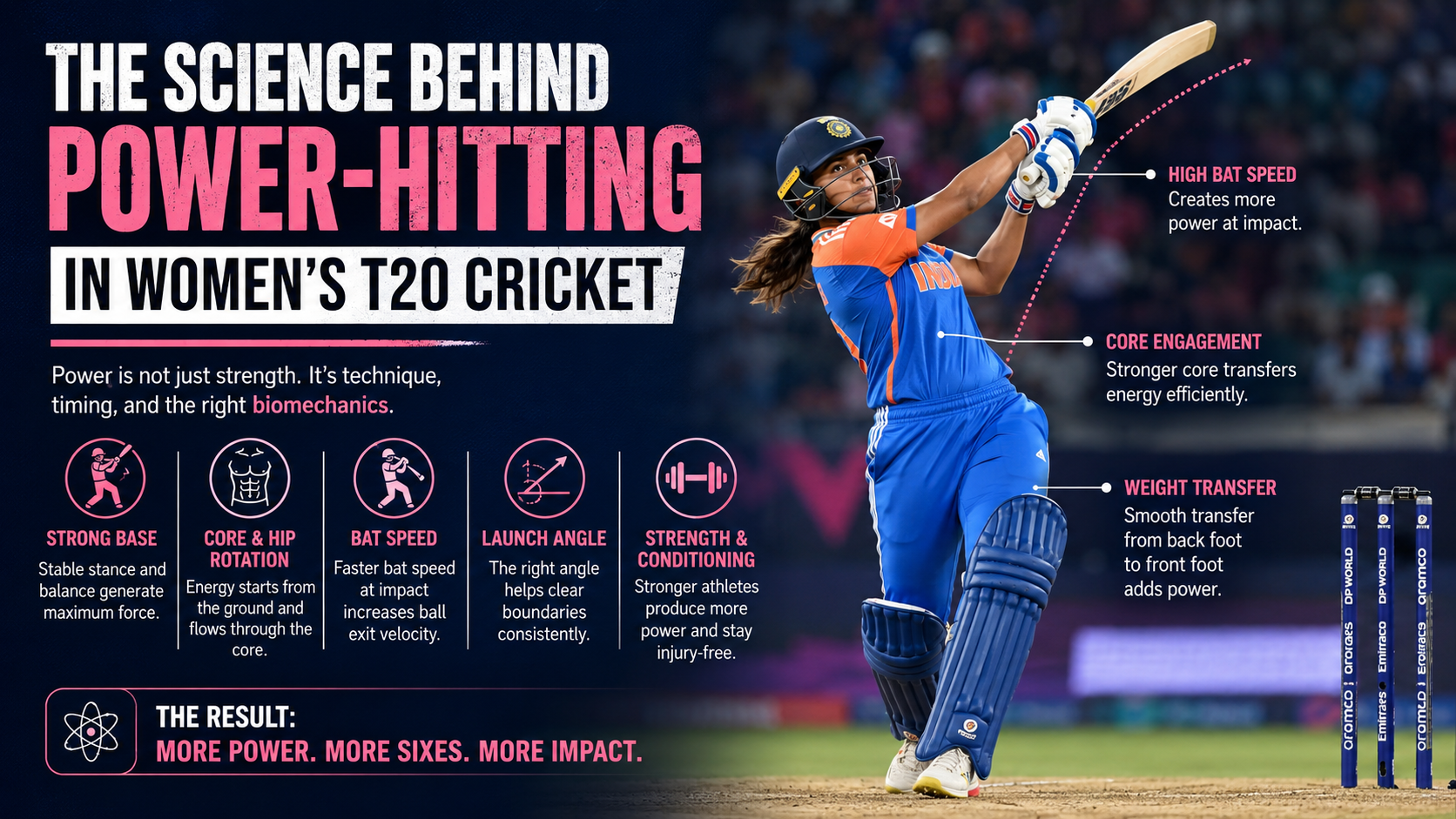
The Science Behind Power-Hitting in Women’s T20 Cricket
Women’s T20 cricket has undergone a remarkable transformation over the past decade. What was once a format dominated by placement, timing, and running between the wickets is now witnessing an explosion of sixes, aggressive batting, and match-changing power-hitting. Modern stars such as Shafali Verma, Sophie Devine, Nat Sciver-Brunt, and Grace Harris have redefined what is possible in women’s cricket by consistently clearing boundaries and scoring at extraordinary strike rates.
But what exactly makes a player a power-hitter? Is it simply strength, or is there a deeper scientific explanation behind those towering sixes? The answer lies in biomechanics, athletic conditioning, technique, and years of specialized training.
The Evolution of Power-Hitting in Women’s Cricket
The rise of women’s franchise leagues and professional contracts has fundamentally changed batting standards worldwide. Modern players now have access to full-time coaching, advanced sports science support, strength programs, and data-driven training methods.
Research and match data show a significant increase in strike rates and six-hitting frequency in women’s T20 cricket over the last decade. This growth is closely linked to improved athletic development and the increasing emphasis on aggressive batting strategies. ESPN’s analysis of the women’s game highlighted how professionalization has enabled players to focus specifically on developing boundary-hitting skills and power generation.
As a result, teams now actively seek batters who can change a match within a few deliveries rather than simply accumulate runs.
Biomechanics: Where Power Really Comes From
Many fans assume power-hitting is primarily about upper-body strength. Sports science research suggests otherwise.
The majority of batting power is generated from the lower body and core rather than the arms alone. The kinetic chain begins from the ground, transferring energy through the legs, hips, torso, shoulders, and finally into the bat.
Studies examining elite female cricketers found that successful power-hitters display efficient body rotation, strong hip engagement, and excellent weight transfer during ball contact. This coordinated movement allows batters to maximize bat speed while maintaining balance.
A powerful shot typically involves:
- Strong base and balance
- Rapid hip rotation
- Core muscle activation
- Efficient transfer of body weight
- High bat speed at impact
When these elements work together, even players who are not physically large can generate tremendous hitting power.
Bat Speed: The Hidden Weapon
One of the most important factors in power-hitting is bat speed.
Research on batting performance shows that faster bat acceleration significantly increases ball exit velocity. In simple terms, the faster the bat moves through the hitting zone, the farther the ball can travel.
Different players achieve bat speed in different ways:
- Some rely on explosive wrist action.
- Others generate momentum through foot movement.
- Some utilize stronger rotational mechanics.
What matters most is the ability to deliver maximum bat speed precisely at the moment of impact.
This explains why players with different physiques can all become effective power-hitters despite having completely different batting styles.
Launch Angle and Boundary Clearing
Modern cricket increasingly borrows concepts from baseball and golf, particularly the idea of launch angle.
Launch angle refers to the angle at which the ball leaves the bat after contact. Research and coaching analysis show that optimal launch angles increase the likelihood of clearing the boundary rather than finding a fielder.
Elite women’s cricketers train specifically to create ideal bat paths and contact positions that produce both elevation and distance. Coaches often focus on keeping the bat face open through impact while maintaining body shape and balance.
This combination of launch angle and bat speed has become a defining characteristic of modern T20 batting.
Strength Training and Athletic Development
The growth of power-hitting is also closely linked to advancements in physical preparation.
Today’s elite female cricketers spend considerable time in the gym developing:
- Lower-body strength
- Core stability
- Rotational power
- Explosive movement capacity
- Sprint speed and agility
Strength coaches frequently use exercises such as:
- Squats
- Deadlifts
- Medicine ball throws
- Box jumps
- Plyometric drills
These exercises improve force production and help players convert gym strength into cricket-specific power.
The introduction of professional contracts across major cricket nations has allowed athletes to train year-round, resulting in stronger and more powerful players than ever before.
The Role of Match Simulations
Power-hitting is not developed solely through fitness training.
Elite players spend countless hours practicing game scenarios designed to replicate T20 pressure situations. Coaches use bowling machines, target zones, and match simulations to improve decision-making under pressure.
Many teams encourage batters to experiment with aggressive shot-making during practice sessions, helping them develop confidence and muscle memory.
This repeated exposure trains players to recognize scoring opportunities faster and execute boundary options instinctively during matches.
Why Power-Hitting Matters More in T20 Cricket
T20 cricket rewards aggression more than any other format.
Data from modern T20 competitions consistently shows that teams capable of hitting more boundaries and sixes often gain a significant advantage. Power-hitters can rapidly alter match momentum, increase scoring rates, and place bowlers under constant pressure.
The strategic value of six-hitting has become so important that teams now build batting lineups around players capable of clearing the ropes in every phase of an innings. This evolution mirrors broader trends across global T20 cricket, where attacking intent increasingly outweighs conservative accumulation.
The Future of Women’s Power-Hitting
The future looks even brighter for women’s cricket.
With expanding professional leagues, improved sports science support, and growing investment from cricket boards, the next generation of players is likely to be stronger, fitter, and more explosive than ever before.
As coaching methods continue to evolve and technology becomes more sophisticated, power-hitting standards will likely rise further. The gap between men’s and women’s boundary-hitting capabilities is gradually narrowing, and fans can expect even more high-scoring encounters in the years ahead.
Final Thoughts
Power-hitting in women’s T20 cricket is no longer an occasional skill possessed by a select few players. It has become a fundamental part of the modern game. The science behind those massive sixes combines biomechanics, bat speed, launch angle, strength training, and tactical awareness.
What makes today’s generation of female cricketers special is not simply their ability to hit harder—it is their ability to apply advanced athletic preparation and technical precision to maximize every scoring opportunity. As the sport continues to evolve, power-hitting will remain one of the biggest drivers of excitement and innovation in women’s cricket.
Frequently Asked Questions (FAQs)
What is power-hitting in women’s cricket?
Power-hitting refers to the ability to consistently score boundaries and sixes using bat speed, strength, timing, and efficient batting mechanics.
Does power-hitting depend only on strength?
No. Research shows that technique, hip rotation, core stability, bat speed, and launch angle are equally important factors.
Why are more sixes being hit in women’s T20 cricket today?
Professional training, improved fitness standards, advanced coaching methods, and franchise leagues have significantly improved power-hitting abilities.
Which muscles are most important for power-hitting?
The legs, hips, core, and lower body generate most of the force used during powerful cricket shots.
How do players train for power-hitting?
Players combine strength training, plyometric exercises, batting drills, bowling-machine sessions, and match simulations to develop power-hitting skills.