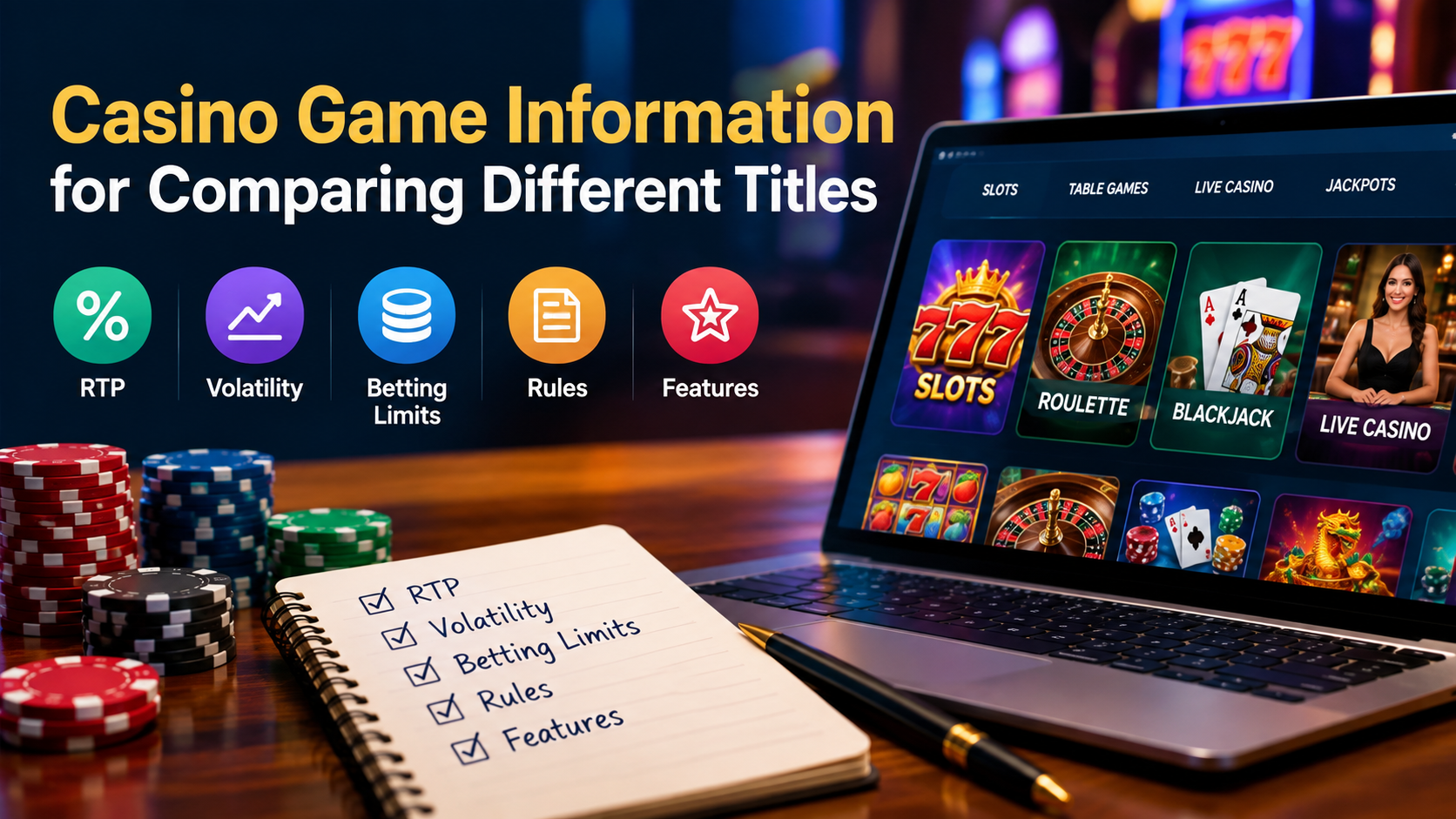
Choosing between casino games can be difficult when several titles look similar on the surface. A modern online casino may offer hundreds of slots, table games, live dealer options, and other formats, each with different rules, features, payout structures, and levels of volatility. Looking beyond the graphics and promotional banners can therefore make game comparison much more straightforward.
This is where casino game information becomes useful. Details such as RTP, volatility, paylines, maximum win, game mechanics, betting range, and bonus features give players a clearer picture of what makes one title different from another.
For anyone comparing games before playing, understanding these details can help create a more informed and structured approach.
What Is Casino Game Information?
Casino game information refers to the details provided about how a particular game works. Depending on the title, this can include:
- Return to Player (RTP)
- House edge
- Volatility
- Minimum and maximum bets
- Paytable
- Winning combinations
- Bonus rounds
- Special symbols
- Maximum potential payout
- Game rules
- Random number generation information
Many games provide these details through an information or help button inside the game interface.
RTP, in particular, is commonly used when comparing games. It represents a theoretical long-term percentage of wagers returned through prizes. Importantly, it does not mean that a player will receive that percentage during a single session. The UK Gambling Commission explains that RTP is an average measured over a significant number of plays and can vary considerably during an individual session.
RTP Makes Game Comparisons More Meaningful
Two slot games can have completely different themes while appearing similar in terms of gameplay. RTP provides one mathematical point of comparison.
For example, imagine two hypothetical slots:
- Game A: 96% RTP
- Game B: 94% RTP
The difference does not predict what will happen during the next spin. Instead, it describes the theoretical long-term return built into each game’s mathematics.
This distinction is important because a high RTP does not guarantee a win. The Gambling Commission notes that RTP is based on a large volume of game plays rather than an individual player’s results.
When comparing titles, players can therefore use RTP as one factor rather than treating it as a promise of short-term results.
Volatility Explains How Wins Are Distributed
RTP alone does not tell the entire story. Volatility is another important part of casino game information.
A lower-volatility game generally distributes smaller wins more frequently, while a higher-volatility game may produce larger wins less frequently. The Gambling Commission describes volatility using statistical measures related to the spread and frequency of prizes.
Consider two slots with the same RTP. They can still provide noticeably different playing experiences because their volatility may differ.
This makes volatility useful when comparing titles with similar theoretical returns. Instead of asking only, “Which game has the higher RTP?”, players can also examine how the game’s potential outcomes are distributed.
Paytables Show What Creates a Winning Combination
A paytable is another useful source of information. It explains how symbols interact and what different combinations can pay.
For slot games, a paytable may show:
- Symbol values
- Wild functions
- Scatter symbols
- Bonus symbols
- Free-spin triggers
- Multipliers
- Special features
- Winning combinations
This information can make it easier to understand the actual mechanics of a title before playing.
For example, two games might both advertise free spins, but the feature could work differently in each one. One may use expanding symbols, while another may rely on multipliers or cascading reels. Reading the game’s information section makes those differences much easier to identify.
Betting Range Helps Players Compare Practical Costs
Betting limits are also worth checking. Games can have significantly different minimum and maximum stake levels.
A player who prefers smaller wagers may find one title more suitable for their chosen budget than another with a higher minimum stake. Looking at the betting range before starting also avoids assumptions based purely on the game’s appearance.
This is particularly useful when comparing games from different providers, as betting configurations can vary even when the underlying game format looks familiar.
Game Type Changes the Information You Need
Not every casino title should be compared using exactly the same criteria.
For slots, RTP, volatility, paytables, bonus mechanics, and maximum potential win can be especially relevant.
For roulette, players may want to understand the wheel configuration and rules. A single-zero European roulette wheel and a double-zero American roulette wheel have different mathematical characteristics.
For blackjack, rules concerning the number of decks, dealer actions, doubling, splitting, and other table conditions can affect the mathematical house advantage.
Live dealer games add another layer because physical equipment and dealing procedures are involved. The UK Gambling Commission notes that live dealer games use physical equipment such as roulette wheels and card decks, with integrity measures surrounding their operation.
The result is a more useful comparison when players focus on the information relevant to the specific game type.
Why Game Information Is More Useful Than Graphics Alone
Visual presentation is often one of the first things people notice. Themes, animations, sound effects, characters, and special effects can make one game look more attractive than another.
However, graphics do not explain the mathematical structure of a game.
A title with impressive animations could have very different RTP, volatility, betting limits, or bonus mechanics from another game with a simpler design.
That is why checking the available game information before playing can provide a more objective basis for comparison.
For additional background on game mechanics and RTP concepts, the UK Gambling Commission’s RTP guidance provides useful regulatory information.
How Players Can Compare Casino Titles Step by Step
A simple comparison process can make large game libraries easier to navigate.
1. Identify the game type
Start by deciding whether the title is a slot, roulette game, blackjack variant, baccarat game, live dealer title, or another format.
2. Check the RTP or house edge
Look for the game’s published mathematical information where available.
3. Review volatility
Consider whether the game is designed around more frequent smaller prizes or less frequent larger outcomes.
4. Read the paytable
Check how symbols, winning combinations, bonus features, and multipliers work.
5. Check the betting range
Make sure the available stakes fit within the budget you have already decided to use.
6. Understand special features
Free spins, wilds, multipliers, jackpots, bonus rounds, and other mechanics can substantially change how a title plays.
7. Compare similar games
Once the information is collected, compare titles with similar formats rather than judging them only by appearance.
Players looking for broader casino game information can also review game-specific guides and descriptions before deciding which titles they want to understand in greater detail.
Information Can Also Help Avoid Common Misunderstandings
Casino game information is useful partly because it can correct common assumptions.
For example, RTP does not mean that a player is guaranteed to receive a specific amount during a session. Likewise, previous spins do not automatically determine what happens on the next spin in a random game.
The Gambling Commission states that random machines use statistical chance and that outcomes on the current game are not affected by previous wins or losses.
Understanding these points helps keep game comparisons focused on documented mechanics rather than patterns or predictions that the game’s information does not support.
FAQs About Comparing Casino Games
What is the most important information to check in a casino game?
RTP, volatility, betting limits, paytable information, game rules, and bonus mechanics are useful starting points. The relevant details depend on the type of game.
Does higher RTP guarantee better results?
No. RTP is a theoretical long-term measurement and does not predict the outcome of a particular spin, hand, or session.
Why should players check volatility?
Volatility helps explain how prizes are distributed. Games with different volatility levels can produce very different short-term experiences even when their RTP figures are similar.
Where can casino game information be found?
It is often available through the game’s help, information, rules, or paytable section. Some platforms also provide separate game descriptions.
Are two games with the same RTP identical?
No. They can have different volatility, paylines, bonus features, betting ranges, paytables, and gameplay mechanics.
Can previous results predict the next casino game outcome?
For games using independent random outcomes, previous results do not provide a reliable way to predict the next result. Game information should be used to understand mechanics rather than predict individual outcomes.
Final Thought
Comparing casino games becomes much easier when the decision is based on more than graphics and promotional descriptions. RTP, volatility, house edge, paytables, betting limits, rules, and special features provide useful information for understanding how different titles are designed.
The key is to compare like with like and remember that statistical information describes long-term game characteristics, not guaranteed individual results. Taking a few moments to read the game’s information before playing can make the differences between titles much clearer and support more informed choices.